Skip to content

Touch Tennis vs 타입티: What’s Actually Different?

CEO & Technical Expert at Pickleball Equipment Company (아트 피클볼)
Specialize in manufacturing pickleball paddles, pickleball balls, and pickleball accessories.
Touch tennis vs TYPTI looks like an obvious comparison because both are scaled-down racket sports played with a short strung racket and a foam ball. But they are 닫다 cousins, not twins. Touch tennis is the older, more tennis-style format with its own compact court, while TYPTI is built for standard pickleball courts with a larger higher-bounce ball and its own scoring and net rules. Here is where they actually diverge, and how to decide which one is worth your time.
The quick verdict: are touch tennis and 타입티 the same thing?
No, but they are built on the same idea. Touch tennis is the established original: a shrunk-down version of tennis on a dedicated small court, launched in 2002 and grown through a grassroots competitive circuit. 타입티 is the newer arrival, engineered specifically to be played on existing pickleball courts and pushed hard by a celebrity-backed team led by Tennis Channel founder Steve Bellamy.
Play both and the family resemblance is obvious: low-compression foam ball, short strung racket, real tennis strokes and spin. If you want the full rundown on the newer sport on its own, we cover what 타입티 is separately; here the focus is how it stacks up against touch tennis. The differences that matter show up once you are keeping score, buying gear, or deciding what to put on your court. 타입티 is best understood as a pickleball-court-native reworking of the touch tennis concept, with its own rules and its own commercial engine.
Touch tennis vs 타입티 at a glance
Before digging into each difference one by one, here is the whole comparison in a single view. The table lines the two sports up across the specs that decide how each one plays, what it costs to run, and where it fits.
| Feature | Touch Tennis | 타입티 |
|---|---|---|
| Launched | 2002 | Emerged 2026 |
| Behind it | Rashid Ahmad, grassroots circuit | Steve Bellamy (Tennis Channel founder), celebrity investors |
| Court | Dedicated small court, about 40 x 20 ft | Standard pickleball court, 44 x 20 ft |
| Ball | 3.15-inch high-density foam | 3.5-inch “channeled” foam, higher bounce |
| Racket | 21-inch strung | 22-inch strung (OLO brand, around $199) |
| Non-volley zone | None (tennis-style) | None (volleys allowed anywhere) |
| Scoring | Short sets to 4, one serve, no let | “Stakes” scoring (three straight points) |
| Net rule | Standard | Ball off your own side of the net can stay in play |
| Maturity | Established community and tournaments | New, venture and celebrity backed |
Where they actually differ
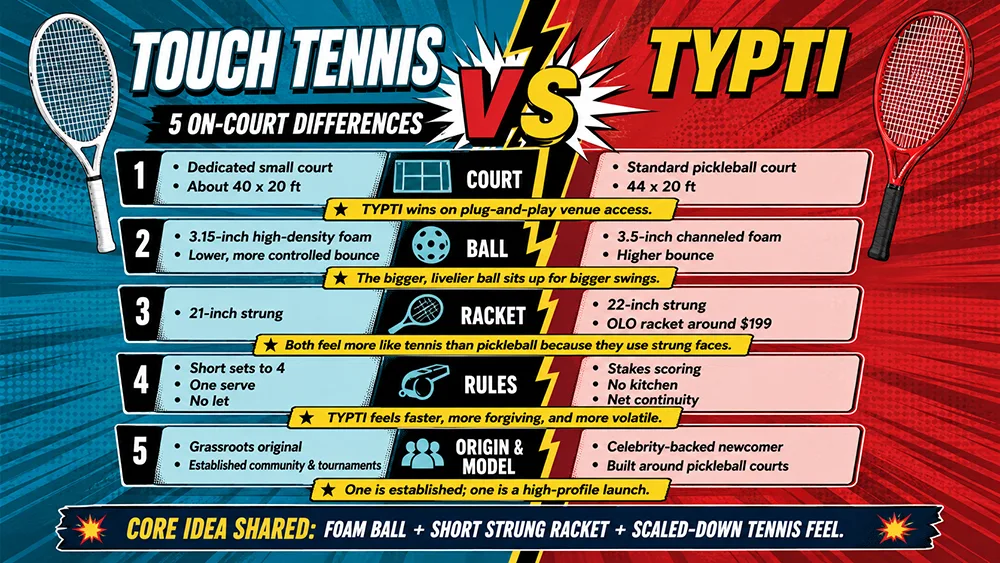
The table gives you the headline; this is where those specs turn into real differences on court. Five things separate touch tennis from 타입티 in practice, and they build on each other, starting with the one that drives all the rest: the court.
Court: dedicated small court vs the pickleball rectangle
The clearest strategic split is court space. Touch tennis was designed around its own compact court, roughly 40 by 20 feet, shorter than a pickleball court, so clubs typically mark out a dedicated surface for it. 타입티 does the opposite: it is built to drop straight onto the 44-by-20-foot pickleball court that thousands of venues already have. That is not a small design decision. It is the whole go-to-market strategy. 타입티 does not ask a facility to build anything new, which is exactly why you see it turning up wherever pickleball lines already exist.
The ball: high-density foam vs channeled higher-bounce foam
Both sports use a soft foam ball instead of a pressurized tennis ball, which is what keeps rallies slower and the noise down. But they are not the same ball. Touch tennis uses a 3.15-inch high-density foam ball tuned for a low, controllable bounce that rewards tennis technique on a small court. 타입티 uses a larger 3.5-inch “channeled” foam ball designed to bounce noticeably higher: one retailer breakdown puts it at roughly 300% higher than a pickleball. A bigger, livelier ball changes the game more than people expect. It sits up higher, invites bigger swings, and plays differently off the same court a pickleball would.
The racket: 21 inch vs 22 inch, both strung
This is where both sports separate themselves sharply from pickleball. Neither uses a solid paddle. Both use a short strung racket, so you can actually brush up the back of the ball and generate real topspin and slice. Touch tennis rackets run about 21 inches; 타입티 rackets are a touch longer at around 22 inches, with the branded OLO racket priced near $199. For a former tennis player, that strung face is the entire appeal, and it is the single feature that makes both sports feel like tennis rather than a paddle game.
The rules: tennis-style sets vs Stakes scoring and no kitchen
Touch tennis keeps scoring 닫다 to tennis: short sets to four games, a single serve, and no let. It feels like tennis with the volume turned down. TYPTI rewrites more of the rulebook. It uses “Stakes” scoring, where you win by taking three points in a row, so momentum swings fast. It eliminates the non-volley zone entirely, so you can volley from anywhere (no pickleball-style kitchen). And it adds a net-continuity twist: a ball that clips your own side of the net can stay in play instead of ending the point. Individually these are small tweaks. Together they give TYPTI a distinct, faster, more forgiving personality.
Origin and business model: grassroots original vs celebrity-backed launch
Touch tennis grew slowly and organically over two decades into a real community with its own tournaments and ranked players. 타입티 arrived with a very different playbook: heavy PR, celebrity investors, and a premium branded racket at around $199. That is not a criticism of either, but it does tell you what you are buying into. One is a mature format with an existing player base; the other is a well-funded newcomer betting that pickleball’s courts and crowds are the fastest route to scale.
What the equipment differences tell you
As a company that manufactures racquet-sport equipment, I read these two sports through their gear, and the gear is honest about the design intent.
The ball tells you the most. A 3.15-inch high-density foam ball and a 3.5-inch channeled foam ball are not interchangeable, and the difference is deliberate. High-density foam with a low bounce keeps play controlled and technical, which suits touch tennis on a smaller court. A larger, channeled, higher-bounce ball is tuned for a bigger court and bigger swings. In practice, foam formulation, wall thickness, and any internal channeling are what decide bounce height, flight stability, and how long the ball keeps its liveliness before it packs down. That is why a small change in ball spec, not the racket, usually changes how one of these games feels.
The racket confirms the shared DNA. Both sports chose a short strung frame over a solid paddle, which is the deliberate line they draw against pickleball. It is also the harder, more expensive thing to build well, which is part of why a branded racket lands near $199 rather than at paddle prices. It is the kind of build we handle directly: we make custom 타입티 rackets alongside balls and nets for these small-court formats, so the string bed, frame stiffness, and balance all have to be right before a batch ships. If you make or source equipment for these emerging formats, the honest takeaway is that the ball is where the playing character lives and the racket is where the cost and the credibility live.
Which one should you play, or stock?
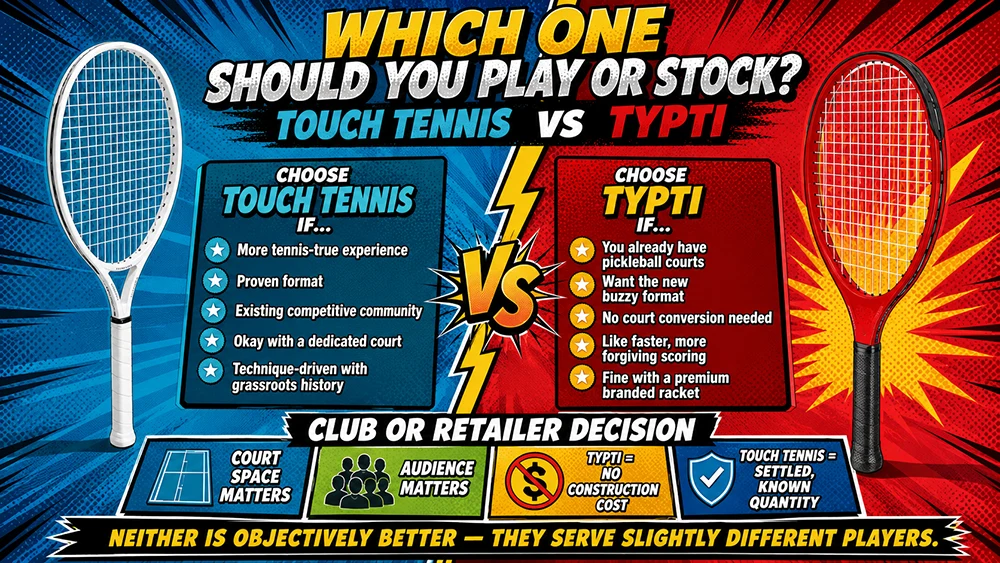
By now the pattern is clear: two 닫다 formats with different priorities. Which one fits comes down to what you already have and what you want out of a session, so here is the simple way to decide.
Choose touch tennis if…
You want the more tennis-true experience, a proven format with an existing competitive community, and you are happy to play on (or mark out) its dedicated court. It rewards technique and has years of grassroots history behind it.
Choose 타입티 if…
You already have pickleball courts and want the new, buzzy format that drops onto them with no conversion, you like faster and more forgiving scoring, and you do not mind buying into a premium branded racket while the sport is young.
For a club or retailer, the deciding factor is usually court space and audience. 타입티’s pitch is that it costs you nothing in court construction; touch tennis’s pitch is that it is a settled, known quantity. Neither is objectively “better.” They serve slightly different players.
The bigger picture: small-court racquet sports and your court space
Touch tennis and TYPTI are two entries in a fast-growing category: scaled-down, foam-ball, strung-racket sports competing for the same casual players and increasingly the same 44-by-20-foot rectangles that pickleball made popular. For anyone building a brand, a club program, or a retail lineup around these formats, the practical questions are the same ones we help buyers work through every day: what ball spec gives the play feel you want, how the racket and court gear are built and priced, and how consistent all of it stays across a production run. If you are weighing a small-court racquet-sports lineup, 아트 피클볼 manufactures custom balls, nets, bags, and custom pickleball paddles, and can help translate a target play feel into a production-ready spec. Start with the format you are backing, then pin down the ball and gear that make it play the way you promised.
FAQs
Is 타입티 the same as touch tennis?
No, but they are closely related. Both use a short strung racket and a foam ball and play like a scaled-down tennis. 타입티 is designed for standard pickleball courts, uses a larger higher-bounce ball, and has its own rules (no non-volley zone, Stakes scoring, net continuity). Touch tennis is the older format on its own smaller court with more tennis-style scoring.
Is 타입티 just touch tennis rebranded?
It is a fair question, and it is the one most people ask. 타입티 is better described as a pickleball-court-native adaptation of the same core idea, with real rule changes and a different commercial model, rather than a straight rename. The concept is shared; the court, ball, and rules are not identical.
Why is it called 타입티?
타입티 is a coined brand name for the sport rather than a descriptive term. Unlike “touch tennis,” the name does not spell out the format, which is part of building it as a distinct, ownable brand.
Do touch tennis and 타입티 use pickleball paddles?
No. Both use short strung rackets, not solid pickleball paddles. That strung face is exactly what lets players hit real topspin and slice, and it is the main thing separating both sports from pickleball.
Can you play 타입티 on a pickleball court?
Yes, that is the entire point of its design. 타입티 uses the standard 44-by-20-foot pickleball court, so venues can host it without building anything new. Touch tennis traditionally uses its own slightly smaller dedicated court.