Skip to content

Padel Racket Types: Shapes, Materials, and How to Choose

CEO & Technical Expert at Pickleball Equipment Company (Art Pickleball)
Specialize in manufacturing pickleball paddles, pickleball balls, and pickleball accessories.
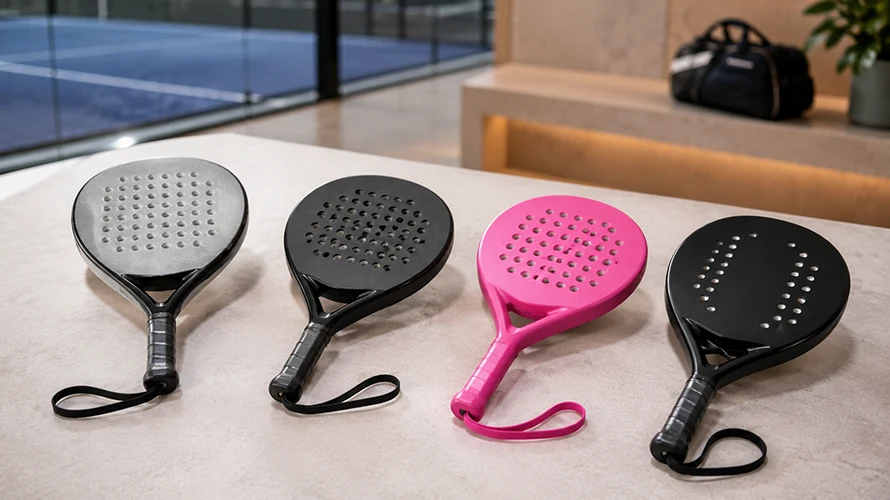
Short answer: padel rackets are sorted by five build choices, and each one changes how the racket plays. The five are shape (round, teardrop, or diamond), face material (fiberglass or carbon), core density (soft to hard EVA), surface finish (smooth or textured), and weight and balance. Most guides stop at shape. The shape gets you in the door, but the racket you actually feel in your hand is the sum of all five.
So when someone asks about padel racket types, the useful answer is not “there are three shapes.” It is “choose the shape, then match the face, core, surface, and weight to the player.” This guide walks through each type, what it does well, where it struggles, and how to put together a combination that fits your level. It does not rank specific brand models, and it does not cover padel rules or scoring.
What Is a Padel Racket
A padel racket is a solid, stringless racket used to play padel. Unlike a tennis racket, it has a perforated hitting surface, a short handle, and a compact frame designed for control, rebound, and maneuverability in the enclosed padel court. Official FIP rules list the racket as two parts, head and handle, with a maximum total length of 45.5 cm, width of 26 cm, and thickness of 38 mm.
Start With Shape: Round, Teardrop, and Diamond
Shape is the first thing people notice and the easiest type to understand, because it decides where the sweet spot sits and how the weight is balanced. Three shapes cover almost every racket on the market, and they sit on a simple line from control to power.
Round rackets: control and forgiveness
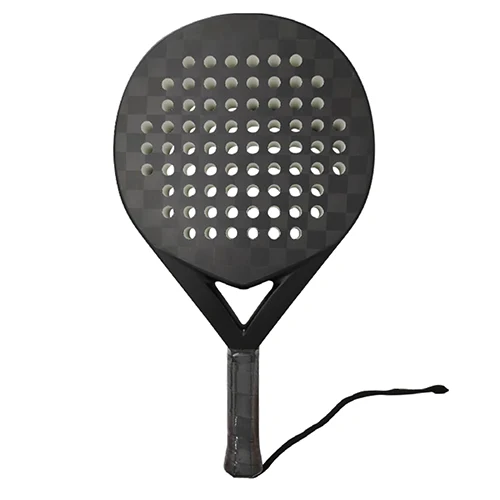
A round racket carries its balance low, near the handle, and puts the sweet spot in the center of the face. That makes it the most forgiving shape and the easiest to control. It is the safe default for beginners and improvers, and many experienced defensive players never leave it because quick hands at the net matter more to them than a heavy smash. If you are not sure where to start, start here.
Teardrop rackets: the all-round middle
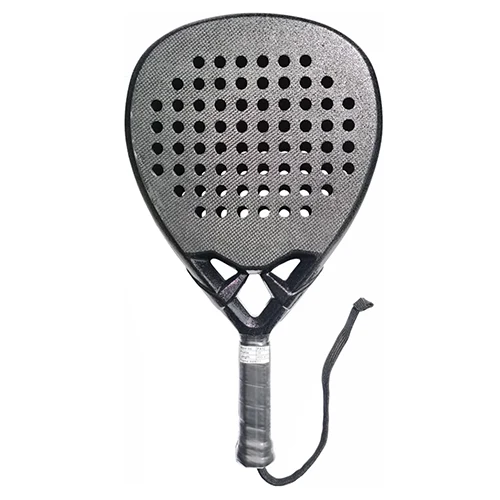
Teardrop sits between round and diamond. The sweet spot moves a little higher up the face and the balance is roughly even, so you get more power than a round racket without giving up much control. This is the most common recommendation for intermediate players who want one racket that does a bit of everything, and it is usually the shape that suits the widest range of people.
Diamond rackets: power for experienced players
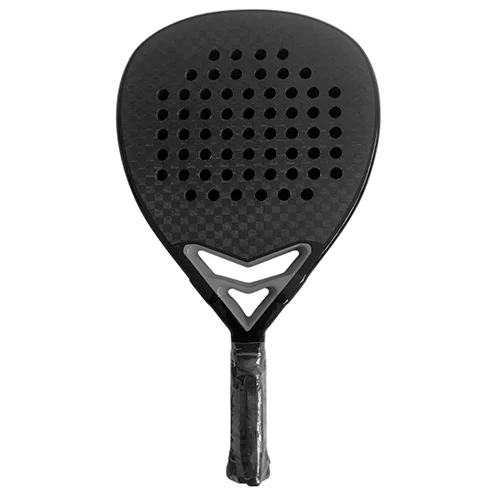
A diamond racket carries its balance high, toward the top edge, and pushes the sweet spot up with it. That delivers the most power on the smash and rewards an aggressive game. The trade is real: the sweet spot is smaller and less forgiving, and the racket asks for good timing and a faster swing. Pick a diamond too early and you give up a lot of control for power you cannot use yet, with sore mishits as the receipt.
| Shape | Balance | Sweet spot | Plays like | Best for |
|---|---|---|---|---|
| Round | Low (head-light) | Central, large | Control, forgiving | Beginners, defensive players |
| Teardrop | Even | Slightly higher | Balanced | Intermediate, all-court |
| Diamond | High (head-heavy) | Near the top, smaller | Power, demanding | Advanced, attacking players |
Face Material: Fiberglass vs Carbon
If shape sets the balance, the face sets the feel, and you notice it on the first hit. Padel faces are built mostly from two material families.
Fiberglass faces flex more. They feel softer, more comfortable, and more forgiving, they usually cost less, and they give a slightly springy return that helps when you cannot yet generate your own power. The limit shows up at speed, where that flex costs you some control and precision.
Carbon faces are stiffer. They return more power, point the ball more precisely, and last longer, but they are less forgiving on off-center hits and reward players who bring their own swing speed. For a beginner, a stiff carbon racket can feel like hard work; for a strong player, fiberglass can feel mushy.
What 3K, 12K, and 18K carbon mean
The K number is the count of filaments in each carbon tow, in thousands, so 3K means about 3,000 filaments per bundle. As a rough direction, lower-K weaves tend to feel a little softer and more flexible, while higher-K weaves such as 18K use larger tows that sit flatter and stiffer, which can add power and a firmer response. Treat it as a direction, not a grade. The resin, the layup, and how the face is bonded to the core change the feel as much as the weave does, and a well-built 12K racket can easily out-play a poorly built 18K one. Hybrid faces blend carbon and fiberglass to land between comfort and power.
Core: Soft, Medium, and Hard EVA
The core is the rubber block under the face, and it is the type buyers think about least and feel the most. Padel cores are mostly EVA foam, sorted by density.
- Soft EVA: more comfort, more control, more forgiveness, and easier on the arm. It returns a little less power and is the friendlier choice for newer players.
- Medium EVA: the balanced middle that suits most intermediate players.
- Hard EVA: more power and a faster, more responsive feel for players who hit hard. It asks for a stronger swing and gives up some comfort.
Temperature matters more than people expect. Rubber stiffens in the cold and softens in the heat, so a soft core can feel lively on a cold morning while a hard core comes alive in summer. Some rackets use a plush FOAM core instead of EVA for extra comfort and pop; FOAM feels soft and lively, but EVA is generally more consistent and holds up better over a season of heavy play. In practice, I would match core density to how hard someone hits and the climate they play in, not to whatever a spec sheet calls “pro level.”
Surface Finish: Smooth or Rough, and Why It Changes Spin
Surface finish is a type too, even though it is only the top skin of the face, and it mostly affects spin and durability. A smooth or glossy surface gives cleaner contact and lasts longer, with a little less grab on the ball. A rough or textured surface, whether a sand coat or a raised grit pattern, bites the ball more and helps with slice and topspin.
The catch is wear. A rough surface smooths down with use, and the spin effect fades as it does, so the texture should be judged by how it holds up, not just how it grabs when new. Spin is also the easiest thing to over-promise in this sport. Texture helps, but technique helps more. If a surface claim sounds magical, ask how it is tested.
Weight and Balance: The Type Behind the Type
Weight and balance do not get their own shelf in a shop, but they quietly decide how every other type feels in a rally.
Most adult rackets land roughly between 350 and 375 grams, with lighter and heavier options on either side, and an overgrip plus an edge protector nudges that number up. Lighter rackets are easier to swing and kinder to the arm; heavier rackets add power but tire you faster and ask more of the shoulder and elbow.
Balance is where the racket carries that weight. A low, head-light balance gives control and quick hands at the net, while a high, head-heavy balance adds power on the smash and is slower to maneuver. This is why shape and balance are always discussed together: round rackets usually sit low, diamonds sit high, and teardrops sit in between. One practical rule cuts through all of it: if a player is new to the sport or has any history of tennis elbow, lean lighter and lower-balanced regardless of shape.
How to Choose a Padel Racket Type by Level and Style
Here is where the five types come together. The quickest path is to set your level first, then nudge the choice toward how you like to play.
| Level | Shape | Face | Core | Weight/Balance | Why |
|---|---|---|---|---|---|
| Beginner | Round | Fiberglass or hybrid | Soft | Lighter, low | Forgiveness and comfort while you learn |
| Intermediate | Teardrop | Hybrid or 12K carbon | Medium | Mid, even | One racket for power and control |
| Advanced | Diamond or teardrop | 12K or 18K carbon | Hard | Mid-heavy, high | Power and precision for an attacking game |
Then adjust for style. Control players who live at the net do well on a round or teardrop shape, a softer core, and a low balance. Power players who hunt the smash lean toward a diamond shape, a hard core, a stiff carbon face, and a high balance. All-court players who do a bit of everything are the reason teardrop sells so well.
Common Mistakes When Choosing a Padel Racket Type
Most racket regret comes from picking a type for the wrong reason, and a few patterns show up again and again.
- Buying a diamond for the power before the swing is ready. The power is real, but so are the mishits and the sore forearm.
- Choosing a racket because a pro uses it. Pros can handle stiff, head-heavy, low-forgiveness rackets that punish the rest of us.
- Reading a higher carbon K number as a quality score. It is a weave spec, not a grade.
- Ignoring weight, balance, and grip size, which decide comfort more than the headline material does.
For brands sourcing rackets rather than buying one, two more mistakes are common: copying a competitor’s spec sheet without locking the core density, face layup, and surface tolerance that actually create the feel, and launching too many models before one configuration is proven. A spec sheet should not require a treasure map.
What the Types Mean If You Are Building or Sourcing Padel Rackets
For a player, the five types are a buying decision. For a brand, distributor, or club building its own line, they become production decisions, and each one carries a cost and a tradeoff. Shape decides which open mold or custom frame you start from. The face is a fiberglass, 3K, 12K, 18K, or hybrid layup. The core is an EVA density, or FOAM. The surface is glossy, matte, sand, or textured. Weight and balance set the target weight window and where the mold places mass.
This is the stack we work through with brands: pick the shapes for the target market, set the face and core by price tier and player level, choose a surface that balances spin against wear, and lock a weight window the factory can repeat batch to batch. Art Pickleball builds custom padel rackets across round, teardrop, and diamond frames, with fiberglass and 3K, 12K, and 18K carbon faces, soft, medium, and hard EVA cores, and glossy, matte, sand, and textured finishes, with in-house testing for fatigue, frame stress, impact, and shot. One boundary worth stating plainly: in-house testing checks durability and consistency, not legality. Rackets meant for sanctioned play are built to meet the sport’s equipment rules set by the International Padel Federation, and official approval is a separate step from a factory’s own testing.
The bottom line is that there is no single best padel racket type, only the combination that fits the player. Set the shape for the sweet spot you want, the face and core for the feel, the surface for spin and wear, and the weight for comfort. Get those five right and the racket disappears in a good way: you stop thinking about it and start playing.
If you are planning a padel line rather than buying a single racket, the useful next step is to write down the target market, the shapes you want, a face and core direction by price tier, a surface finish, and a weight window, then pressure-test that against sampling and reorder reality. Share it as a project brief and our team can turn it into custom padel rackets with the branding, packaging, and testing plan to match.
FAQs
Which padel racket shape is best for beginners?
Round. A round racket balances low and centers the sweet spot, so it is the most forgiving and easiest to control while you build technique. You can move to a teardrop later if you want more power.
Is a carbon or fiberglass padel racket better?
Neither is better overall; they suit different players. Fiberglass flexes more and feels softer, more comfortable, and more forgiving, which helps beginners and players with arm issues. Carbon is stiffer and gives more power, precision, and durability, which suits stronger, more aggressive players.
What weight padel racket should I use?
Most adult rackets sit roughly between 350 and 375 grams. Lighter rackets are easier to swing and kinder to the arm, while heavier rackets add power but tire you faster. If you are new to the sport or have any elbow history, choose lighter.
Does a rough racket surface actually add spin?
It helps a little. A textured or sand surface grabs the ball more for slice and topspin, but technique matters more than texture, and a rough surface smooths down with use, so the effect fades over time.
What are the holes in a padel racket for?
Padel rackets are solid and stringless, and the holes drilled through the face reduce weight and air drag so the racket swings faster. The hole pattern also fine-tunes stiffness and where the sweet spot sits, so it is part of the design rather than just decoration.
What padel racket type is best for power players?
A diamond shape with a high balance, a hard EVA core, and a stiff carbon face gives the most power. It is also the least forgiving setup, so it pays off only when your swing speed and timing can use it.