Skip to content

Pickleball Ball Hole Count Rules (26 vs 40 vs 48)

CEO & Technical Expert at Pickleball Equipment Company (Art Pickleball)
Specialize in manufacturing pickleball paddles, pickleball balls, and pickleball accessories.
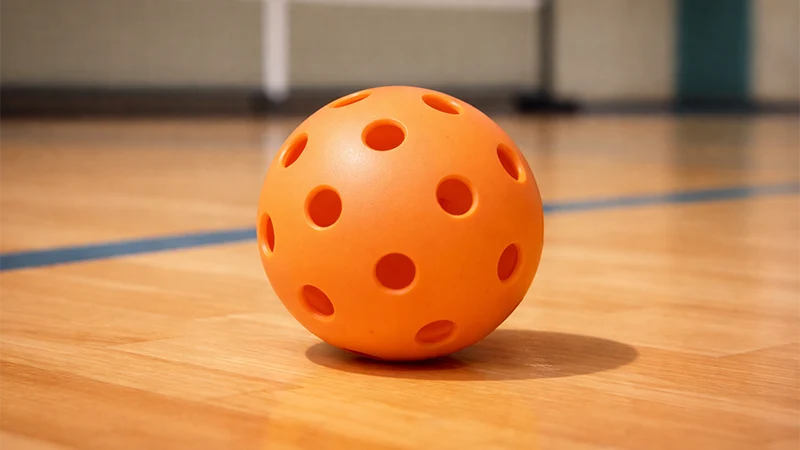
Pickleball balls do not all have the same number of holes.
And that is not a cosmetic detail.
Hole count changes flight stability, speed, and how the ball feels in wind.
It also affects whether a ball can be used under certain rule sets.
Fast answer
Most indoor pickleballs are commonly 26 holes.
Most outdoor pickleballs are commonly 40 holes.
Under USA Pickleball equipment standards, an approved ball design must fall within 26 to 40 circular holes, which means 48-hole designs sit outside that approval spec.
If you are choosing a ball for league or tournament play, always confirm the organizer’s ball policy first.
Why hole count exists at all
Pickleball is basically controlled aerodynamics.
The holes do three jobs:
- Reduce drag so the ball travels a predictable distance.
- Stabilize flight so the ball does not wobble mid-air.
- Balance speed and touch, especially on dinks, resets, and drives.
Change the number of holes, and you are changing how the ball interacts with air.
The “standard” you see most often: 26 holes and 40 holes
You will hear people talk as if there are only two legitimate hole counts.
That is because, in day-to-day play, there usually are.
26-hole balls (most common indoor setup)
Typically used on smooth indoor surfaces where wind is not a factor.
Players choose 26-hole balls because they tend to feel:
- Slightly softer and slower
- Easier to control at lower speeds
- Less “skippy” on smooth floors
40-hole balls (most common outdoor setup)
Typically used on outdoor hard courts where wind and rough surface texture matter.
Players choose 40-hole balls because they tend to feel:
- More wind-stable than most indoor balls
- More predictable on harder outdoor surfaces
- “Crisper” at contact
Important note: many people treat “40-hole” as the outdoor default, but the real world is broader than that. Some models use other hole counts within the allowed range.
Quick comparison table: 26 vs 40 vs 48 holes
| Hole count | Where it’s commonly used | Typical play feel | Wind stability | Rule-set risk |
|---|---|---|---|---|
| 26 | Indoor | Softer, a bit slower | Low need | Low |
| 40 | Outdoor | Crisp, predictable | Strong | Low |
| 48 | Organizer-defined events, some high-performance preferences | Fast, stable, “true flight” feel | Strong | Higher if the event requires USA Pickleball approval |
The key takeaway is the last column.
Hole count is not only performance. It can be a compliance filter.
Where “rules” enter the conversation
Players often ask: “How many holes are allowed in a pickleball?”
That depends on which rule set the event follows.
USA Pickleball standards (common reference point)
USA Pickleball’s equipment standards specify a design range for ball holes.
If an event is USA Pickleball sanctioned or requires an approved ball, the hole count range matters.
That is why 48-hole balls can create confusion.
They may be chosen as an “official ball” for certain organizer-defined environments, but that does not automatically mean they meet USA Pickleball approval specs.
If you want the practical, tournament-focused version of this explanation, read: Are 48-Hole Pickleball Balls Tournament Legal?.
How to pick the right hole count for your use case
Use this simple decision tree.
If you play in a sanctioned event or an “approved balls only” league
- Do not guess.
- Ask for the official match ball model.
- Confirm the organizer’s written policy.
If you run a club, facility, or private league
Pick one “match ball” and enforce it.
That solves 90% of arguments before they happen.
A clean policy looks like this:
- League matches use the published match ball.
- Open play uses any ball agreed by both sides.
If you are choosing a 48-hole ball for performance reasons
You are usually optimizing for:
- Stability in outdoor air
- Consistency on hard contact
- A faster, more “pro” feel
For the performance breakdown behind 48 holes, read: What Makes a 48 Holes Pickleball Ball Different?.
And if you need specs, samples, or OEM pricing for a 48-hole pro ball, go here: Pro 48 Holes Pickleball Ball.
Buyer tip: what matters more than hole count when ordering in volume
If you are buying for a club, distributor, or private label line, hole count is only one variable.
Consistency is the real product.
Before you place a bulk order, validate:
- Diameter tolerance and roundness control
- Weight tolerance by batch
- Seam consistency (for two-piece construction)
- Bounce and compression consistency
- Cold-weather durability expectations for your market
That is what keeps returns and complaints low.
FAQs
Q1. How many holes are allowed in a pickleball?
It depends on the rule set. USA Pickleball equipment standards specify a 26 to 40 circular hole design range for approved balls.
Q2. Are indoor pickleballs always 26 holes?
Most are, but not all. “26 holes” is the most common indoor configuration because it plays well on smooth surfaces with no wind.
Q3. Are outdoor pickleballs always 40 holes?
Most are, but not all. “40 holes” is the most common outdoor configuration because it tends to be stable in wind and predictable on hard courts.
Q4. Why do some balls have 48 holes?
Some players and organizers prefer the flight and feel of certain 48-hole designs. Whether you can use one in competition depends on the event’s ball policy.
Q5. What should I check before using a 48-hole ball in a tournament?
Confirm whether the event is sanctioned or requires an approved ball, and verify the organizer’s published match ball model.