Skip to content

What Is a Pickleball Ball? Size, Holes, Rules, and Buying Guide

CEO & Technical Expert at Pickleball Equipment Company (Art Pickleball)
Specialize in manufacturing pickleball paddles, pickleball balls, and pickleball accessories.
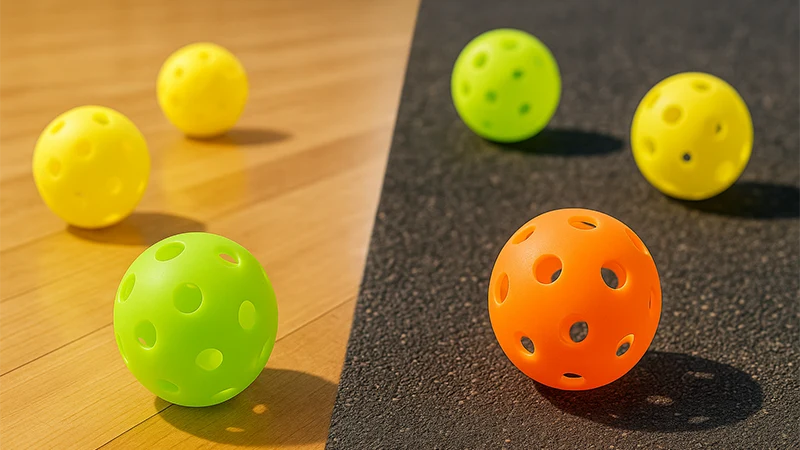
Most people first ask “what is a pickleball ball?” when they see the bright yellow sphere flying over a low net on a crowded court.
If you run a club, a school program, or a brand, that simple question quickly becomes practical.
- Which balls should we buy?
- How long will they last?
- And what will they really cost over a season?
This guide looks at the pickleball ball from your side of the net.
What Is a Pickleball Ball?
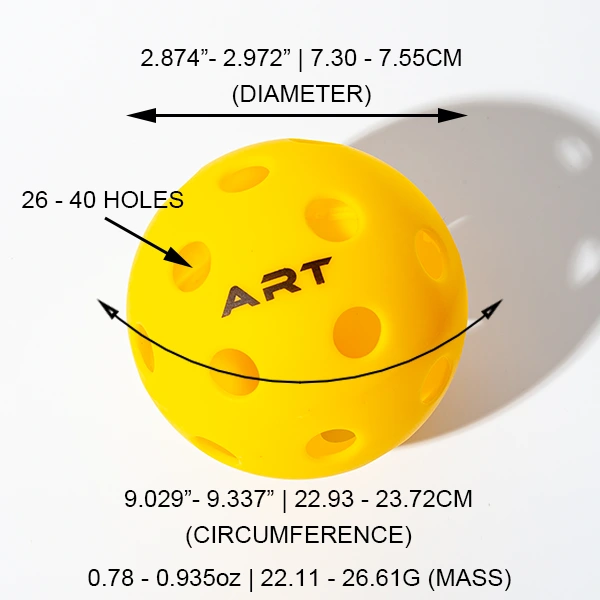
A pickleball ball is a hollow, perforated plastic ball designed to meet USA Pickleball equipment standards.
For USA Pickleball–approved play, balls must fit tight limits for diameter, weight, bounce, and hole count (26–40).
The “right” ball depends on where you play (indoor vs outdoor), your climate, and whether you need USA Pickleball approval.
Official specs in plain language
Under USA Pickleball equipment standards, a regulation ball is a hollow, perforated plastic sphere with fairly tight tolerances:
- Diameter: 2.87–2.97 inches (7.29–7.54 cm).
- Weight: 0.78–0.935 ounces (22.1–26.5 g).
- Bounce: dropped from 78 inches (198 cm) onto a granite surface, it should rebound 30–34 inches.
- Hole count: between 26 and 40, evenly distributed around the surface.
- Compression: tested using a standardized method, with an average result below 43 lbf (ASTM F1888).
- Hardness: often reported as Durometer D for consistency, but best treated as reference data rather than a pass/fail rule.
- Surface and color: smooth, uniform color (except identification marks), with any logos clearly readable.
The rules do not care whether the ball is bright neon or classic yellow.
They care that it is consistent.
That consistency is what lets players move between courts and tournaments without feeling like they are learning a new game every time.
For most facilities and clubs, the simplest way to check tournament legality is to pick models that appear on the current USA Pickleball Approved Ball List.
For OEM and private-label projects, you can still design your own ball.
If you want the product to be eligible for approval, your spec sheet needs to stay inside the standards ranges above.
Indoor vs Outdoor Pickleball Balls (Plus Quiet and Training Options)
On paper, a “pickleball ball” is one thing.
On the shelf, you will see several families of balls, each tuned to a different environment.
Outdoor balls:
- Typically 40 smaller holes on USA Pickleball–approved outdoor models.
- Harder shells to survive concrete and asphalt.
- Faster through the air, more skid on the bounce, louder impact sound.
Indoor balls:
- Often 26 larger holes, better suited to calmer air and smoother surfaces.
- Slightly softer feel, a bit more dwell time on the paddle, quieter on wood or synthetic flooring.
Quiet or foam balls:
- Solid or high-density foam construction, no hard shell.
- Lighter impact sound, slower pace, more arc. Useful for noise-sensitive communities, school gyms, and multi-use halls.
- Typically not used as match balls in sanctioned events, but very useful to keep courts open where noise is a concern.
Training balls:
- Can be foam or softer plastic.
- Designed for beginners, juniors, or skills sessions where control and safety matter more than pure realism.
We manufacture USA Pickleball–style hollow balls in 26-hole (indoor) and 40-hole (outdoor) patterns, plus quiet foam options.
Specialty hole patterns can be produced for training or niche use cases.
If USA Pickleball approval matters, stay within the 26–40 hole requirement.
Pickleball ball types at a glance:
| Ball type | Common hole count | Feel & pace | Wind stability | Noise | Best for | Sanctioned play? |
|---|---|---|---|---|---|---|
| Outdoor ball | Commonly 40 | Firmer, faster, more “crisp” | Better in wind | Louder impact sound | Concrete/asphalt outdoor courts | Yes, if the model is USA Pickleball–approved |
| Indoor ball | Commonly 26 | Slightly softer, a bit slower | Not designed for wind | Typically quieter | Wood or synthetic sport floors | Yes, if the model is USA Pickleball–approved |
| Quiet / foam ball | No holes (foam varies) | Softer contact, slower pace | Varies by design | Much lower impact noise | Noise-sensitive venues, schools, multi-use | Typically no (practice/noise control) |
| Training ball | Varies (some are 48-hole) | Built for control/safety/drills | Varies by goal | Varies by material | Beginners, juniors, skills sessions | Depends; many designs are non-sanctioned |
Important note on “legal” balls:
For USA Pickleball–approved play, hole count must be within 26–40, and the specific model must appear on the USA Pickleball Approved Ball List.
If you see 48-hole balls, treat them as training or specialty balls unless the tournament explicitly allows them.
Are pickleball balls the same as wiffle balls
No. They look similar, but they are built for different games and different flight behavior.
Pickleball balls are designed to meet tight limits for size, weight, bounce, and hole count, so rallies feel consistent from court to court.
Wiffle balls are designed to “break” and curve in the air with a larger, lighter construction, and they do not follow USA Pickleball equipment standards.
If you use a wiffle ball in pickleball, you will usually get a floatier flight, a different bounce, and less predictable feel, especially outdoors.
For drills, it can be fun.
For real play, it changes the game.
What are pickleball balls made of
Most standard pickleball balls are made from hard plastic polymer blends.
Different brands use slightly different recipes to balance three competing goals: crisp bounce, crack resistance, and consistent roundness.
Outdoor balls are often formulated to stay firm and stable on abrasive courts, while indoor balls may be tuned slightly softer for smoother floors and quieter play.
Quiet balls are different.
They are usually dense foam or a softer construction designed to reduce the sharp impact “pop,” trading speed and feedback for lower noise.
If you want a ball that plays close to sanctioned conditions, choose a USA Pickleball–style hollow plastic ball in the 26-hole (indoor) or 40-hole (outdoor) format.
Why the Ball You Choose Matters for Your Courts and Your Budget
You just saw how indoor, outdoor, quiet, and training balls are built for different environments.
That difference is not theoretical.
At club and school scale, it becomes an operating decision that shows up in staff time, player complaints, and reorders.
If you only play once a week at a rec center, most balls feel “fine” as long as they do not crack quickly or fly unpredictably.
For a facility manager or PE teacher, the wrong ball choice turns into a year of small problems.
- More ball chasing.
- More cracked shells in the trash.
- More complaints about noise.
- And more reorders that quietly drain the budget.
Every ball choice has trade-offs:
- Harder outdoor balls survive abrasive concrete better, but they can crack faster in cold weather.
- Softer indoor balls feel better on gym floors, but they wear out or deform sooner if you use them on rough outdoor courts.
- Quiet foam balls keep neighbors happier, but they change the pace of play and typically aren’t used in sanctioned matches.
- Cheap, no-name balls reduce unit cost, but inconsistent bounce and durability create a “lottery” experience on court.
At scale, you are not just buying a box of balls.
You are choosing how your courts will sound, how predictable rallies will feel, and how often staff have to reorder.
To make those calls with intent, not guesswork, the next sections break down durability, noise, and failure modes you can actually plan around.
Anatomy and Materials: How a Pickleball Ball Is Built
Most descriptions stop at “it’s a plastic ball with holes.”
For clubs, schools, and brands, the more useful question is simpler.
What inside the ball decides whether it stays round, resists cracking, and plays consistently over hundreds of games.
Construction methods: how the shell is made
Regulation-style hollow pickleball balls are most commonly made as a hollow shell, then finished to achieve consistent roundness and hole geometry.
Here are two manufacturing approaches you will see in the market.
Injection-molded pickleball balls:
- Plastic pellets are melted and injected into precision steel tooling.
- Two half shells are formed, then fused into a single ball.
- The hole pattern is created by controlled cutting (for example CNC or precision drilling), or by a validated production method that keeps hole geometry consistent.
- The advantage is tight control over wall thickness, roundness, and repeatability at scale.
Rotational-molded pickleball balls:
- A measured amount of material is placed into a hollow mold that is heated and rotated so the plastic coats the interior surface.
- The result can be a very even wall distribution when the process is well controlled.
- Holes are created after cooling, and finishing steps are applied.
- The trade-off is typically slower throughput and more process sensitivity, so it is used selectively depending on the design and volume.
At Art Pickleball, we can produce both styles depending on your targets.
The right method depends on your priorities.
Cost, volume, durability goals, and the exact feel you want players to experience.
Materials: shell blends, foam, and compostable options
The material recipe matters as much as the mold.
Shell materials (engineered polymer blends):
- Hollow balls are typically made from engineered polymer blends tuned for crisp bounce and crack resistance.
- A tougher formulation helps the ball survive cold-weather brittleness and repeated impacts.
- Small formulation and processing changes can noticeably shift “lively vs firm” feel, especially across different temperatures.
Foam quiet pickleball balls:
- Quiet pickleball balls replace the hard shell with dense foam or a softer construction designed to reduce the sharp impact “pop.”
- They compress more on impact, shedding more energy internally instead of as audible sound.
- They are useful for noise-sensitive venues such as HOAs, school gyms, and multi-use halls where maintaining access matters.
- For sustainability-minded projects, compostable or bio-based formulas can be explored as pilot or limited-run concepts.
- These options are best positioned as part of a broader sustainability initiative rather than a one-for-one replacement for every high-intensity outdoor match ball.
- If your courts are busy and abrasive, durability and consistency usually remain the primary constraints.
Choosing between these materials is both an engineering decision and a brand decision.
A junior program may value softer, quieter balls.
A performance program may demand a harder, more consistent shell that stays close to sanctioned match conditions.
What the holes actually do
Players often treat hole counts as simple labels.
“26 is indoor, 40 is outdoor.”
But aerodynamics is doing the real work.
Hole count and size:
- More, smaller holes (commonly 40 on outdoor balls) tend to reduce the effect of wind by letting air pass through the ball more smoothly.
- Fewer, larger holes (commonly 26 on indoor balls) tend to behave better in calmer indoor air and can produce a slightly softer, floatier flight.
Pattern consistency:
- Poorly aligned or inconsistent holes destabilize airflow around the ball.
- That can show up as wobble, drift, and unpredictable movement even when players hit the same shot twice.
- That is why controlled hole cutting and tight QC on hole geometry matter as much as the material.
Wall thickness near the holes:
- This area is where cracks often start.
- Keeping thickness uniform and avoiding sharp internal stress points is one of the biggest levers for lifespan.
- A ball can meet basic specs and still fail early if hole-adjacent thickness and stress control are poor.
Once you see the ball as a combination of material recipe, wall thickness, and aerodynamic pattern, it becomes clear why two “legal” balls can feel very different on court.
Performance, Noise and Failure: When a Ball Is “Dead”
Facilities rarely replace every ball just because a date on a calendar says so.
In real programs, balls cycle out when they stop behaving the way players expect.
A ball is “dead” when it still looks usable, but it no longer plays predictably.
That usually shows up as slower pace, inconsistent bounce, wobble in flight, or a noticeable change in sound and feel.
Bounce, speed and feel across different balls
Players notice three things first.
Bounce height and pace:
- A fresh outdoor ball on a hardcourt jumps quickly off the surface.
- It keeps rallies fast and aggressive.
- After weeks of play, that same ball may still be intact, but feel “flat.”
- Lower bounce.
- Slower pace.
Sound:
- Impact noise is more than a neighbor issue.
- It is part of the feedback loop players rely on.
- A crisp “pop” often means the shell still feels stiff.
- A dull “thud” often means the ball has softened or lost resilience.
- Sound is a clue, not a lab test.
- But in a bucket of mixed balls, it is a useful signal.
Feel on the paddle:
- Stronger players feel small changes right away.
- How deeply the ball sinks into the face.
- How quickly it comes back out.
- How reliably it carries spin and stays on line.
Quiet foam balls deliberately change all three.
- Softer contact.
- Slower pace.
- Much lower impact sound.
That is a feature in the right environment, as long as everyone understands the trade-off.
Common failure modes: cracks, eggs and “mushy” balls
Across brands and constructions, the same failure patterns show up again and again.
Cracks and splits:
- Often start at or between holes.
- They may run along a seam line on two-piece shells.
- Cold temperatures and very hard hitters can accelerate this.
- Many clubs see a spike in cracked balls when evenings turn chilly.
Out-of-round “egg” shapes:
- Repeated high-load impacts on the same panel can deform the shell over time.
- The ball may still bounce.
- But flight becomes unstable.
- Trajectories wobble.
- Players describe it as the ball “dancing” in the air.
Softening and loss of bounce:
- Material fatigue and micro-cracking can leave the shell more flexible.
- Players describe these balls as “mushy.”
- They feel slow.
- They stick to the paddle more.
- They drop short on dinks.
Surface wear:
- On rough asphalt, the surface gradually scuffs and flattens.
- That does not always make a ball unusable.
- But it can reduce consistency and the amount of spin players can apply.
A good production and QC system reduces premature failures caused by poor molding, uneven thickness, or bad material control.
What it cannot do is stop normal wear from thousands of serves, drives, and hard bounces on abrasive courts.
Typical lifespan by ball type and environment
No two facilities see exactly the same numbers.
Court texture, temperature, player level, and how balls are rotated through buckets all matter.
But most programs plan around broad ranges.
Outdoor balls on concrete or asphalt:
- Under heavy play with strong hitters, some balls may crack within 2–3 sessions.
- Under typical club use, many facilities plan to refresh buckets after roughly 10–20 sessions.
- Or sooner if you start seeing obvious cracks, eggs, or wobble.
Indoor balls on wood or synthetic sport floors:
- Surfaces are kinder, so lifespan often extends to roughly 20–40 sessions in many programs.
- Deformation and softening become the main reasons to retire a ball.
Quiet foam balls:
- Foam does not “crack” the same way plastic does.
- It gradually loses resilience.
- They are usually retired when they feel noticeably slower, less lively, or out of balance compared to newer balls.
If you want more certainty, treat testing as part of procurement.
In product development, we can run controlled impact and durability tests to compare designs, materials, and hole patterns under repeatable conditions.
In daily play, the practical rule is simpler.
When a bucket starts to feel inconsistent, refresh it.
Players will feel the difference immediately, and your staff will spend less time chasing problems that look small but add up all season.
Matching Balls to Facilities: Scenarios for Clubs, Schools and Communities
Ball choice stops being abstract when you map it onto real venues and real people.
Below are three scenarios we see often when talking with club operators and purchasers.
Outdoor hard courts and league play
A typical community club might run multiple outdoor courts on concrete or asphalt.
Open play runs during the day.
Leagues, ladders, and tournaments show up in the evenings.
Players expect a quick, aggressive game, and many bring their own paddles.
For this environment:
- A USA Pickleball–style 40-hole outdoor ball with a tough, cold-resistant polymer blend is usually the best baseline.
- Consider running two “grades” of balls. A house ball for open play and casual rentals. A fresher batch reserved for league nights and club tournaments.
Outdoor balls live a harder life.
Planning replacement cycles matters more.
As a practical rule, once a bucket is roughly 20–30% cracked, out of round, or obviously inconsistent, demote it to training use and rotate a new batch into circulation.
If you want to go deeper on court surface, climate, and how hole patterns affect wind stability, see our guide on indoor vs outdoor pickleball balls.
Indoor gyms and multi-use spaces
Schools, churches, and city recreation centers often repaint existing basketball or volleyball courts for pickleball.
Wood and synthetic sport flooring is kinder to balls and to players’ joints.
But noise and shared use become bigger concerns.
In these spaces, a 26-hole indoor ball with a slightly softer feel is a solid compromise.
- Bounce stays high enough for dynamic play, but the ball does not feel like a rock on the paddle.
- Impact noise is typically lower than hard outdoor balls on concrete, especially when the shell is tuned away from extreme stiffness.
For beginners, juniors, and PE classes, foam training balls are also worth serious consideration.
They travel more slowly.
They reduce the sting of mishits.
And they are far less likely to disrupt a yoga class in the adjacent hall.
Noise-sensitive neighbourhoods and HOAs
One of the fastest-growing use cases for quiet balls is residential courts.
Courts installed near homes can face complaints long before they reach full utilisation.
In many noise discussions, the sharp paddle-to-ball impact sound is the main friction point.
HOAs and municipalities increasingly look for credible noise guidance when approving new courts or setting operating hours.
In these locations:
- A quiet foam ball can reduce impact noise by a noticeable margin.
- The game feels a little slower and “softer,” but you gain the social license to keep courts open.
- Some operators run quiet balls during early mornings and evenings, then switch to standard balls at midday when fewer residents are home.
We produce foam quiet balls alongside standard hollow balls, so facilities can combine both in their operating policy instead of treating it as an either-or choice.
Planning Inventory and Total Cost of Ownership
Once you know which ball types fit your venue, the next question is practical.
How many balls do you actually need.
And what will they cost you over a season.
How many balls you really need per court
There is no universal rule.
But a practical way to plan is to separate “in-play balls” from “backup stock.”
Per active court:
- For open play and social sessions, plan for at least 4–6 good balls in circulation at any time.
- For structured drills or coaching, 6–12 balls per court keeps practice flowing.
Per facility:
- For a small club with four courts, starting with 1–2 cases per ball type you use regularly is a common baseline.
- For a larger venue with eight to twelve courts, an initial stock of 4–6 cases is common, depending on how aggressively you want to rotate fresh balls into buckets.
Many facilities also maintain a separate stash of “premium” balls for league nights and tournaments.
Those balls see fewer random hits into fences and posts, which usually extends their useful life.
Replacement cycles and budgeting
Instead of trying to predict exact lifespans, it is usually more effective to budget on a cycle.
Estimate usage intensity:
- Is the venue busy all day with wait lists.
- Or is it a private club with structured booking and time limits.
Set a review cadence:
- Inspect and cull cracked or badly deformed balls every 2–4 weeks.
- Demote “tired” balls to coaching buckets before they frustrate league matches.
Budget in batches:
- Plan to swap out a percentage of stock each quarter rather than replacing everything at year-end.
- In colder climates with heavy outdoor play, many programs plan to refresh roughly 30–40% of outdoor balls each season.
- In mild climates or indoor-heavy programs, that percentage is often lower.
Working this way turns balls from a random, reactive expense into a planned line item.
When you pair it with wholesale pricing from a manufacturer, the per-game cost often looks far less intimidating than the sticker price suggests.
Storage, temperature and care
Small habits extend lifespan more than most people expect.
Avoid leaving balls in car trunks or storage sheds that swing from freezing to very hot.
Rotate buckets so older stock is used first, instead of letting one corner accumulate forgotten, brittle balls.
On particularly cold days, some clubs store balls indoors and bring them out just before play to reduce early cracking.
These habits do not cost anything.
They simply use your existing stock more effectively.
Custom and Private-Label Balls: From Idea to Specification Sheet
If you are a distributor or brand owner, “what is a pickleball ball” often turns into a different question.
What do I need to tell a factory so they can build my ball correctly.
Translating rules into OEM specs
The first step is to translate high-level requirements into a one-page technical brief.
At Art Pickleball, we usually start with:
- Target ball type: indoor, outdoor, quiet, training, or a deliberate hybrid.
- Diameter and weight targets that sit inside the USA Pickleball equipment standards window.
- Hole count: if USA Pickleball approval matters, stay within 26–40 holes; if you are building a specialty training ball, define the goal (wind stability, slower pace, quieter impact) and we can discuss non-sanctioned patterns.
- Shell material: standard engineered polymer blends, a cold-resistant option for colder climates, or special formulas for specific feel targets.
- Color and finish: matte or slightly glossy; uniform base color with clear identification marks and readable branding.
This document does not need to read like an engineering textbook.
It just needs to be specific enough that an OEM line knows what tooling approach, material recipe, and QC checks to run.
Color, branding and packaging options
A ball is also a moving piece of brand identity.
On that side of the spec sheet, consider:
- Custom colors aligned with your club or brand palette.
- Logo placement via screen printing or other methods, keeping marks readable and consistent.
- Packaging: classic tubes, cardboard boxes, hanger bags, or bulk cartons. Retail packs for shelves versus plain master cartons for club backrooms. For marketplaces like Amazon FBA, label placement and barcode requirements matter.
Art Pickleball routinely matches custom colors, applies screen printing, and designs packaging that suits both brick-and-mortar retail and e-commerce.
Because we also produce pickleball paddles, we can align paddle and ball branding in a single project instead of treating them as separate worlds.
When it makes sense to consider certification
Not every ball needs to appear on the USA Pickleball Approved Ball List.
For some buyers, the product is aimed at beginner bundles, indoor community programs, or quiet practice sets where certification adds more cost than value.
Certification becomes worth exploring if:
- Your ball will be the official ball of a tournament series or league.
- You plan to sell into facilities that advertise strict compliance with the USA Pickleball official rulebook requirements.
- Your brand positioning is heavily performance-oriented, and you want an approval pathway that purchasers can verify.
In those cases, we help customers align their spec with the required ranges and discuss test samples, iteration cycles, and timelines.
Even when you choose not to certify, using those standards as design targets helps keep play close enough that players can transition to listed balls without a shock.
Inside the Factory: How Art Pickleball Manufactures Balls
Many buyers only ever see the finished ball and the invoice.
Understanding what happens between those two points helps you judge whether a supplier is truly a pickleball balls manufacturer or just a trading middleman.
From pellets to finished balls: a typical production flow
A simplified version of our production line looks like this:
- Material preparation: TPE or other polymer pellets are dried and conditioned to the correct moisture content.
- Molding: For injection-molded balls, melted material is injected into precision molds to form half shells, which are then fused. For rotational-molded balls, measured pellets coat the inside of a rotating heated mold, forming seamless spheres.
- CNC hole drilling: Once shells are cooled, CNC machines drill the pattern of 26, 40 or 48 holes with tight positional accuracy.
- Deflashing and surface finishing: Any sharp edges or flash are removed; surface texture is tuned so the ball feels consistent to the touch.
- Printing and branding: Logos and markings are screen-printed according to the client’s artwork.
- Quality inspection: Samples from every batch are measured for diameter, weight and roundness. Bounce tests and visual inspections catch obvious defects before packing.
- Packing and palletising: Balls go into their specified packaging—tubes, boxes, bags or bulk cartons—then onto pallets sized for container loading or direct distribution.
Quality checks, including 120 km/h and 3,000-hit testing
Beyond basic dimensions, Art Pickleball uses focused durability tests:
- Machine arms fire balls at paddles or hard plates at 120 km/h to simulate heavy hitting.
- Each sample must survive 3,000 impacts without cracking to pass the benchmark.
- Low-temperature and high-temperature storage tests help ensure the ball doesn’t turn brittle in winter or overly soft in summer.
These tests do not guarantee that no ball will ever fail on your courts—that’s impossible.
They do show that the design has been stressed well beyond casual open play before it carries your logo.
Coordinating balls, paddles and packaging in one project
Because we also design and manufacture paddles and packaging, a growing number of clients ask for a complete kit:
- Branded paddles tuned to their target player level.
- Matching balls (for example, 40-hole outdoor game balls plus quiet foam practice balls).
- Retail or club packaging that presents everything as one coherent system.
In these projects, artwork, colour matching and logistics are handled in one place.
For clubs and retailers, that can mean one PO instead of three, and a stronger brand story from the first unboxing.
How to Brief a Manufacturer (and Questions to Ask Before You Order)
You don’t need a long technical background to run a good procurement process.
You just need to ask structured questions and capture the answers.
Checklist for clubs, facilities and schools
When a club or school comes to us asking for recommendations, we usually start with a short conversation that covers:
- Courts and surfaces: How many courts, indoor or outdoor, and what surfaces?
- Player mix: Mostly beginners and social players, or many high-level competitors?
- Noise context: Any existing or expected noise complaints from neighbours, other hall users or local authorities?
- Usage pattern: Busy all day, or concentrated into a few peak hours?
- Budget comfort zone: Is the priority lowest unit price, lowest cost per game, or a balance with premium feel?
From those answers we can propose a combination such as:
- 40-hole outdoor balls for league nights.
- 26-hole or slightly softer balls for indoor sessions.
- Quiet foam balls during early morning and late evening slots.
A follow-up email summarises the proposed mix, estimated lifespans, and recommended initial order quantities.
Clubs who want more depth on durability and replacement strategies can always explore a dedicated guide on how long do pickleball balls last.
Checklist for distributors and private-label brands
For distributors and brands, the conversation shifts toward product positioning:
- Target customer: Club bulk purchase, Amazon bundles, specialty pro-shop, or big-box retail?
- Performance level: Aimed at beginners, intermediates, or competitive players?
- Product family: Balls only, or balls plus paddles and accessories?
- Certification plan: Do you need, or merely want, listing on the USA Pickleball Approved Ball List?
- Order structure: One global version, or region-specific variants (e.g., cold-climate shell formula)?
A good brief turns into a spec sheet and quotation instead of a long thread of vague emails.
It also gives you something to compare across suppliers if you are still at the scouting stage.
Final Thoughts
In the end, a pickleball ball is just another piece of equipment until you connect it to your courts, your players and your budget.
Once you understand how construction, materials and hole patterns affect bounce, noise and lifespan, choosing between indoor, outdoor, quiet, foam or custom balls becomes a practical design choice instead of a guessing game.
If you’re planning a new facility, refreshing a school program or building a private-label line, share a few details about your surfaces, player mix and constraints, and we’ll help you turn that into a clear ball plan that fits both your gameplay and your numbers.
FAQs About Pickleball Balls
1. What ball do you use for pickleball?
For most players, you’ll use a USAPA-approved outdoor ball on outdoor asphalt or concrete, and an indoor ball on wood or synthetic courts.
If you only play casually, a solid “club” or “recreational” ball is fine—as long as it’s an actual pickleball, not a tennis or wiffle ball.
If you play leagues or tournaments, match your practice ball to whatever model they use in your area.
2. What is the difference between indoor and outdoor pickleball balls?
Indoor balls usually have fewer, larger holes (often 26), and are a bit softer and slower, built for smooth wood or sport floors.
Outdoor balls use more, smaller holes (commonly 40, sometimes more on pro models), and are harder and more wind-stable for rougher courts.
If you take an indoor ball outside, it tends to float and scuff quickly; a hard outdoor ball indoors often feels too fast and too loud.
3. How long should a pickleball ball last?
It depends on your courts, climate, and level of play.
For casual outdoor play, a decent ball can feel good for anywhere from 10–20 hours; in hard club or tournament use, players may rotate balls every few hours or even every match.
Once a ball is cracked, clearly out of round, or feels dead compared to the others in your bucket, it’s time to retire it to drills or throw it out.
4. Can you use tennis balls or wiffle balls to play pickleball?
You can hit them around for fun, but they won’t play like real pickleball.
Tennis balls are pressurized, felt-covered, and much bouncier; wiffle balls are thinner, lighter, and designed to curve, not stay true.
If you want realistic rallies and proper practice, use proper pickleball balls—they’re built for the smaller court, underhand serve, and non-volley zone rules.
5. Are quiet or foam pickleball balls legal in tournaments?
Most quiet and foam balls are not approved for standard USA Pickleball–sanctioned events.
They’re designed to reduce noise and impact, which makes them great for neighborhoods, rooftops, kids, and seniors—but they usually don’t match official specs for hardness, weight, and bounce.
For leagues or tournaments, always check the approved ball list; for rec play in noise-sensitive areas, quiet or foam balls can be the smartest choice.
6. Are pickleball balls safe for kids and seniors?
Used correctly, pickleball balls are generally safe for kids and older players—especially compared with harder, faster sports.
The main risks come from hard, high-speed balls hitting eyes or faces, and from repeated impact on sore joints.
If you’re working with kids, seniors, or rehab groups, choose softer or foam balls, keep play controlled, and consider basic eye protection for higher levels.
7. How many holes are in a pickleball ball?
Most indoor balls have around 26 larger holes, and most outdoor balls have around 40 smaller holes.
Some advanced outdoor designs go beyond that—like 48-hole pro balls—to fine-tune flight and wind stability.
As long as the ball meets the official size, weight, and bounce specs, different hole counts and patterns are just different engineering approaches to the same problem.
8. What balls do pro players and major tournaments use?
Pros and big tournaments almost always use approved, pro-grade outdoor balls on outdoor hard courts.
The exact brand and model can vary by tour, sponsor, and region, but they’re all on the official approved list and tend to be harder, faster, and more consistent than basic rec balls.
If you want your practice to feel like those events, pick a ball from that same group; if you’re running a club or brand, you can also build your own pro-style ball line on a similar performance platform.