Skip to content

What Makes a 48 Holes Pickleball Ball Different?

CEO & Technical Expert at Pickleball Equipment Company (Art Pickleball)
Specialize in manufacturing pickleball paddles, pickleball balls, and pickleball accessories.
- What Is a 48 Holes Pickleball Ball
- The Science Behind the 48 Holes
- Flight Performance: Straighter, Smoother, More Predictable
- Material & Durability: Built to Last
- Bounce & Spin Control: Feel the Difference
- Designed for Outdoor Play — But Versatile Enough for Both
- Why More Holes Don’t Mean Less Strength
- Who Should Use a 48 Holes Pickleball Ball
- 40 vs. 48 Holes: Quick Comparison
- Choosing the Right 48 Holes Pickleball Balls for You
- FAQs About 48-Hole Pickleball Balls
- Final Thoughts
If you’ve ever picked up two pickleball balls and noticed they feel a bit different — even if they look the same size — you’re not imagining things.
One of the biggest factors behind that difference is how many holes the ball has.
Most balls have 26, 40, or 48 holes, and that last number — 48 — has become a new trend among professional and outdoor players.
So, what exactly makes a 48-hole pickleball ball stand out?
Let’s break it down together.
What Is a 48 Holes Pickleball Ball
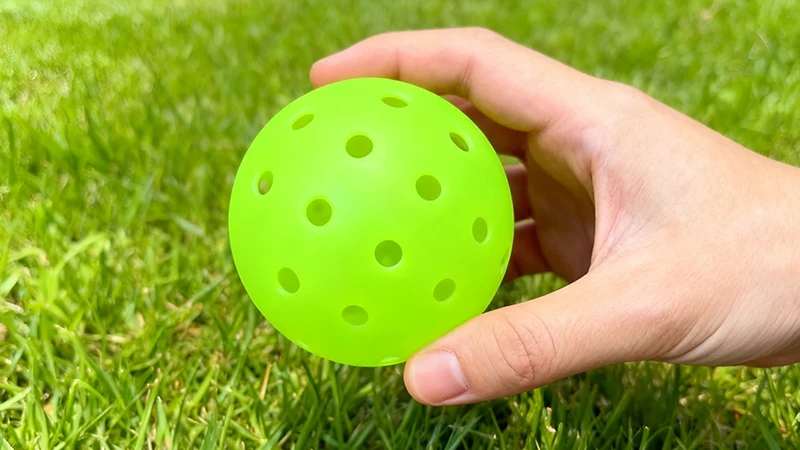
A 48 holes pickleball ball is designed with 48 precision-drilled holes, evenly spaced to balance airflow, bounce, and spin.
Compared to the standard 40 holes outdoor ball, it delivers tighter control, smoother flight, and more consistent performance — especially in windy or humid conditions.
The Science Behind the 48 Holes
Every hole in a pickleball ball affects airflow and stability.
When the ball moves through the air, each hole creates drag — and the more balanced that drag is, the smoother the flight.
A 48 holes design means:
- Smaller holes = reduced air resistance
- Even distribution = less wobble and better directional control
- Higher spin potential = easier to place accurate shots
Think of it like this:
- A 40 holes ball is like a sports car — fast but sensitive to bumps (wind).
- A 48 holes ball is like a luxury car — smooth, controlled, and stable even at high speeds.
Flight Performance: Straighter, Smoother, More Predictable
Wind is every outdoor player’s enemy.
A ball with fewer or larger holes tends to wobble mid-air or get pushed off course.
That’s why many competitive players are switching to 48 holes designs.
They cut through the air more evenly, resulting in:
- Less wind interference
- Better shot placement
- A straighter flight path
It’s particularly noticeable on serve returns and dinks, where control matters more than power.
Material & Durability: Built to Last
Most 48 holes balls are made from high-quality polymer blends, such as seamless rotationally-molded polyethylene.
This ensures:
- Uniform wall thickness
- Longer life span
- Consistent bounce
Because the holes are smaller and evenly spaced, the stress on the material is more evenly distributed — reducing cracks and deformation after long rallies or in cold temperatures.
Bounce & Spin Control: Feel the Difference
Players often describe 48 holes balls as having a “controlled pop.”
That means they don’t jump too high or bounce unpredictably.
Here’s how it feels in play:
- Spin shots: Easier to grip the paddle’s surface
- Dinks: More consistent and predictable
- Serves: Less wobble, more aim precision
If you’re transitioning from indoor to outdoor play, the 48 holes ball gives you that balanced in-between feel — not too fast, not too slow.
Designed for Outdoor Play — But Versatile Enough for Both
Although 48 holse balls are primarily built for outdoor games, many players also use them indoors because of their hybrid performance.
| Environment | Performance |
|---|---|
| Outdoor courts | Excellent wind resistance & flight control |
| Indoor courts | Slightly firmer bounce but still playable |
| Humid weather | Maintains stability & shape |
So if you only want one type of ball that can handle both environments well — the 48 holes design is your go-to.
Why More Holes Don’t Mean Less Strength
A common myth is that more holes make a ball weaker.
That’s not true with modern manufacturing.
In fact, top manufacturers use precision-molded designs that reinforce the structure.
Each hole’s edge is micro-smoothed to prevent cracking and ensure a balanced compression response.
In other words — more holes = better aerodynamics, not fragility.
Who Should Use a 48 Holes Pickleball Ball
You’ll love a 48 holes ball if you:
- Play outdoors and hate how wind ruins your shots
- Prefer smooth, predictable flight
- Like control over raw speed
- Compete in advanced-level matches or club games
Casual players will also notice it’s just more fun to rally with — every shot feels more “clean” and accurate.
40 vs. 48 Holes: Quick Comparison
| Feature | 40 Holes Pickleball Ball | 48 Holes Pickleball Ball |
|---|---|---|
| Hole Size (Diameter) | 7mm | 6mm |
| Airflow | Moderate drag | Smoother, more balanced |
| Wind stability | Good | Excellent |
| Speed | Slightly faster | Slightly slower but steadier |
| Control | Moderate | High |
| Durability | High | Very High |
If you’re serious about refining your game — the 48 holes upgrade is worth it.
Rule note: “tournament legal” depends on the organiser. See Are 48-Hole Pickleball Balls Tournament Legal? before you pick a match ball. If you’re comparing 26 vs 40 vs 48, start with Pickleball Ball Hole Count Rules.
Choosing the Right 48 Holes Pickleball Balls for You
When shopping for pickleball balls, don’t just look at the number of holes — pay attention to:
- Material quality
- Weight and bounce consistency
- USAPA approval
- Durability in cold or hot conditions
At Art Pickleball, we offer pro 48 holes pickleball balls built for both professional and recreational play — combining consistent flight, solid durability, and OEM-ready customization.
FAQs About 48-Hole Pickleball Balls
Q1. Are 48 holes balls tournament-approved?
Some brands are USAPA-approved, but always check the packaging or certification details.
Q2. Can I use them indoors
Yes! While designed for outdoor use, many players enjoy the controlled bounce indoors too.
Q3. Do 48 holes balls last longer than 40 holes ones?
Generally yes — the smaller, evenly spaced holes distribute impact stress more evenly.
Q4. Are they heavier?
Not really. The difference is minimal — but the weight distribution makes them feel more stable.
Final Thoughts
So, what makes a 48-hole pickleball ball different?
It’s all about balance — between speed, control, and durability.
If 40 holes balls are made for power, 48 holes balls are made for precision.
And in a game where every rally counts, that difference could be what takes your play to the next level.