Skip to content

Why Are Pickleball Paddles So Expensive? Understanding the Costs Behind the Price

CEO & Technical Expert at Pickleball Equipment Company (Art Pickleball)
Specialize in manufacturing pickleball paddles, pickleball balls, and pickleball accessories.
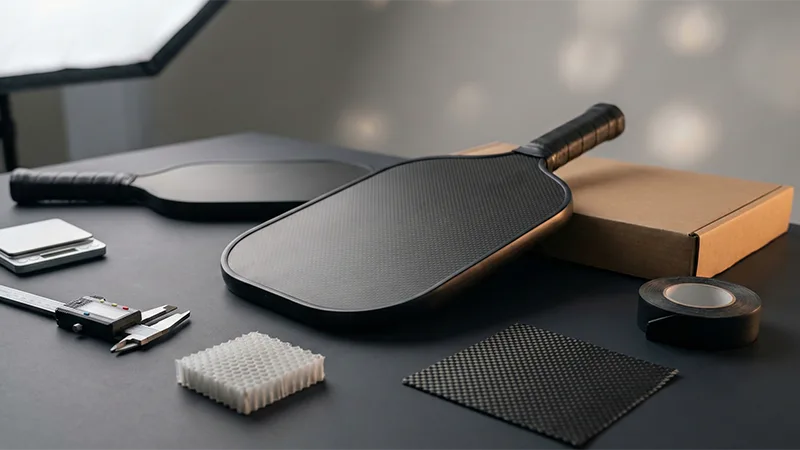
- The Simple Answer: You’re Paying for a Whole System, Not a Sheet of Carbon Fiber
- A Practical “Price Stack” for a $200 Paddle (What Your Money Usually Covers)
- Materials Cost More Than You Think, Mostly Because of Waste and Process Control
- Construction Method Is Where Prices Separate Fast
- “Hot Paddles,” Delamination, and Why Durability Risk Shows Up in Price
- Certification, Testing, and the Cost of Staying “Legal”
- Retail Economics: Why Discounts Are Rare and Prices Cluster Around the Same Numbers
- So Are Expensive Pickleball Paddles Worth It? Use This Buyer Framework
- How to Spend Less Without Getting Burned
- Conclusion
- FAQs
Pick up a modern pickleball paddle and the sticker shock is real. Many models sit in the $150–$250 range, and the “premium” end can go higher, even though the paddle itself looks simple at first glance. The disconnect usually comes from assuming you are paying for raw materials alone, when most of the price is driven by construction complexity, compliance risk, distribution economics, and the cost of keeping performance consistent from batch to batch.
Sometimes you do get measurable performance benefits from higher-end designs. But the bigger reason paddles feel “expensive” is that the market is pricing in everything around the pickleball paddle: R&D cycles, warranty exposure, marketing and sponsorships, retailer margins, and increasingly, testing standards that punish “hot” paddles that change over time.
This article breaks paddle pricing into a simple model you can actually use. You will see what typically drives cost, what is mostly brand economics, and when paying more is rational versus when it is just paying for hype.
The Simple Answer: You’re Paying for a Whole System, Not a Sheet of Carbon Fiber
A high-end pickleball paddle is a laminated sports product with tight performance tolerances. That means the manufacturer is not only building a face and a core, but also managing bonding quality, edge integrity, durability, and “does it stay legal as it breaks in” risk. When you add the realities of modern retail—dealer margins, MAP policies, returns, and sponsorship-driven marketing—the final MSRP can look disconnected from the factory cost.
One brand-side explanation of pricing makes this point bluntly: dealer markup often dominates the economics, with many dealers expecting a large discount off MSRP, and the end buyer effectively funding that distribution layer.
A Practical “Price Stack” for a $200 Paddle (What Your Money Usually Covers)
No two brands have identical cost structures, but the stack below matches how most consumer sporting goods end up priced when sold through normal retail channels. Use it as a mental model rather than a precise accounting statement.
| Cost Bucket | What it Includes | Typical Share of MSRP (Range) |
|---|---|---|
| Manufacturing (COGS) | Core + face materials, pressing/thermoforming, edge/handle assembly, scrap/defects | 15%–35% |
| Quality & Consistency | In-process QC, inspection, rejects, rework, process tuning | 3%–10% |
| Compliance & Testing | Certification submissions, lab testing, re-testing, documentation | 2%–10% |
| Freight & Duties | International shipping, tariffs/duties, warehousing | 3%–12% |
| Warranty & Returns | Replacement units, return handling, customer support | 2%–10% |
| Marketing & Sponsorship | Pro deals, ads, content, event spend | 5%–20% |
| Retail / Dealer Margin | Distributor + retailer margin, MAP-driven pricing structure | 25%–50%+ |
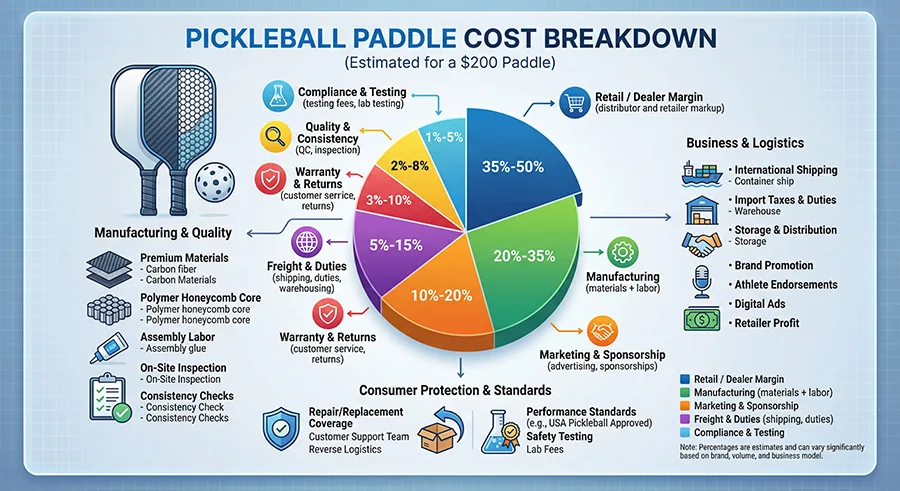
If you only look at the first row, premium paddles feel overpriced. The moment you accept that many paddles are sold through a channel designed to keep MSRP stable (often via MAP-style policies), the math looks far more like other sports equipment categories.
Materials Cost More Than You Think, Mostly Because of Waste and Process Control
Carbon fiber, aramid (Kevlar), fiberglass, and hybrid weaves are not priced like commodity plastics, and they are also not used like commodity plastics. What drives cost is less “the sheet is expensive” and more “the sheet becomes expensive when you must cut, align, bond, cure, and finish it with minimal defects.”
Higher-end faces often require more careful fiber orientation, tighter resin control, and stricter cosmetic standards. Any wrinkle, void, poor bond, or uneven finish is not just a cosmetic issue—it can change feel, spin response, and durability, which increases the rejection rate. That rejection rate is a hidden tax on every “good” pickleball paddle that makes it through.
Construction Method Is Where Prices Separate Fast
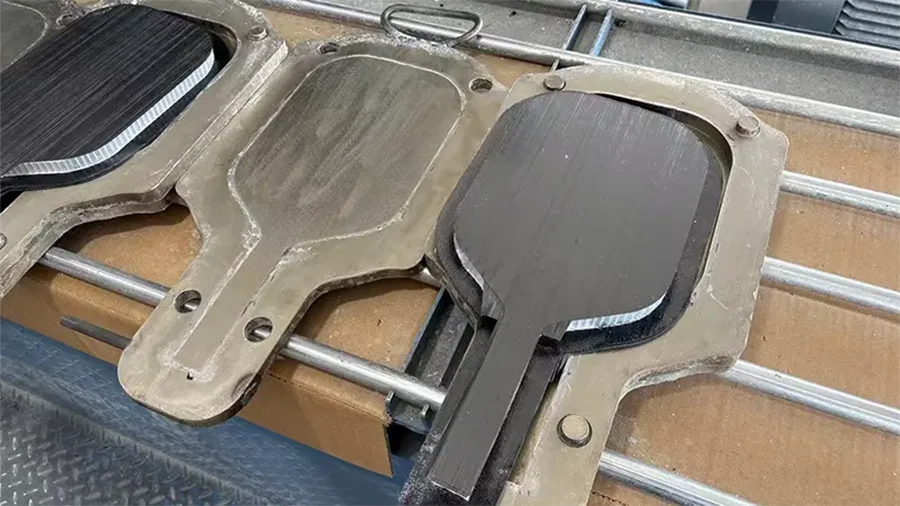
Modern pickleball paddles are not a single material. They are a structure, and structure is cost.
The common “sandwich method” uses a core as the middle layer and face sheets as the outer layers, with edges sealed by an edge guard. Thermoformed designs use heat and pressure to form the paddle and often rely on foam injection and a more integrated build, which can change feel and power characteristics. If you want a clean overview before you compare prices, start with different types of pickleball paddles.
From a cost standpoint, the step-up is not only the equipment. It is also process sensitivity. A more integrated build can demand tighter control over temperature, pressure, cure time, bonding chemistry, and post-process finishing, because small variations can show up as performance inconsistency later.
“Hot Paddles,” Delamination, and Why Durability Risk Shows Up in Price
Delamination is one of the simplest ways to understand why premium pickleball paddles carry price pressure. When internal layers separate, performance can become inconsistent, and in some cases the paddle can feel noticeably more powerful due to a trampoline-like effect, which creates obvious compliance risk for competitive play.
This matters because brands price in what they expect to replace. If a design family is more prone to break-in changes or warranty claims, the brand either tightens QC (cost goes up) or eats warranty losses (cost still goes up). Either way, durability risk becomes part of MSRP.
Certification, Testing, and the Cost of Staying “Legal”
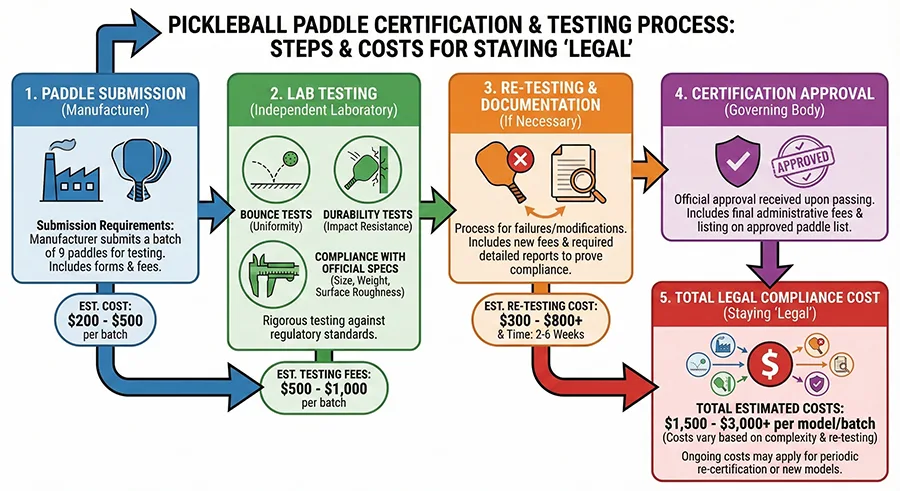
Testing is not a marketing checkbox anymore. It is an operational cost.
USA Pickleball’s submission rules illustrate the scale: for paddle submissions, the current requirement is nine paddles shipped to five separate locations, and submitted paddles are not returned. Their published guidance also lists typical testing timelines (weeks for normal testing, faster for expedited).
On the pro side, UPA-A has published fee structures and timing for certification, including an annual brand fee and per-paddle certification fees, with paid expedited options and multi-week testing windows depending on the year’s program.
Even if a consumer never thinks about certification, the brand has to fund it up front. And if standards tighten or a model needs re-submission, that cost repeats.
Retail Economics: Why Discounts Are Rare and Prices Cluster Around the Same Numbers
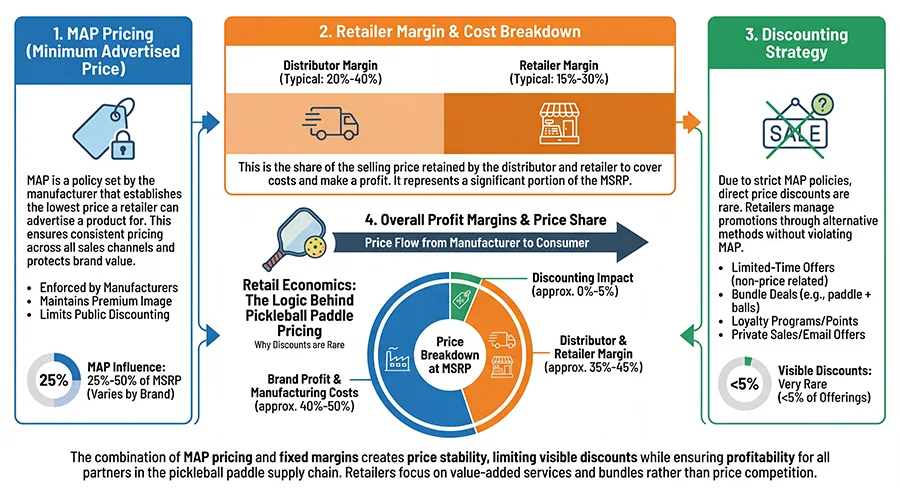
Many buyers assume paddles are expensive because brands are greedy. In practice, the sport runs on a familiar retail structure: MSRP is set to support retailer margin, and discounting is constrained so the brand can keep distribution relationships intact.
A brand-side explanation of this dynamic points directly at dealer markup, arguing that a large part of the final price exists to support the dealer layer rather than the paddle itself.
You can also see this reality in how paddles are sold. When a category is strongly influenced by MAP-style pricing expectations, “shopping around” often yields the same price across many stores, and competition moves to bundles, loyalty programs, or limited promotions rather than real price cuts.
So Are Expensive Pickleball Paddles Worth It? Use This Buyer Framework
The right way to judge value is not “cheap vs expensive.” It is “does this price tier solve my problem.”
| Player Type | What You Actually Need | Sensible Budget Band |
|---|---|---|
| New / casual | A predictable sweet spot, decent durability, comfortable grip | $50–$120 |
| Recreational regular | Better stability, more consistent touch, nicer face feel | $100–$180 |
| League / tournament amateur | Tighter control at speed, reliable reset feel, confidence under pressure | $150–$250 |
| Power-focused or gear-maxing | Specific feel + power profile, willing to pay for marginal gains | $200+ |
If you are still developing fundamentals, the paddle rarely fixes the core issue. But once you are playing faster exchanges and you can feel stability, dwell time, and vibration differences, the premium tier can buy consistency and comfort, not just “more spin.”
If you’re not sure which paddle fits your level, check out our guide on how to choose the right pickleball paddle to help you make the most informed decision based on your play style.
How to Spend Less Without Getting Burned
If you want value, aim for “last year’s flagship” or a proven mid-tier design from a brand with strong warranty handling. Avoid chasing hype constructions without enough track record, because early-generation designs often carry higher variance and higher failure modes, which brands and buyers both end up paying for.
It also helps to separate “performance features” from “marketing features.” A better handle and a stable face are real. A dramatic claim about secret polymers rarely changes your win rate if your footwork and shot selection are not there yet.
Conclusion
Pickleball paddles are expensive because the price includes more than materials. You are paying for a manufacturing process that must stay consistent, a product that must survive real play without turning “hot,” a compliance path that costs time and money, and a retail system that takes a meaningful share of MSRP. If you buy with a simple framework—problem first, features second—you can spend less and still get a paddle that plays the way you expect.
If you’re developing a pickleball paddle for your own brand and want manufacturing, testing alignment, and stable mass production support, contact Art Pickleball.
FAQs
Q1. Are expensive paddles mostly marketing?
Marketing is part of the price, but it is not the whole story. Construction sensitivity, QC, warranty exposure, and retail margins often explain more of the MSRP than the raw material itself.
Q2. What does “USA Pickleball approved” actually imply for cost?
It implies the brand paid for submission, testing logistics, and maintaining a compliant production spec. USAP’s submission FAQ shows the scale of what brands must ship and that submissions are not returned, which is a direct cost input.
Q3. Why do paddles get banned after being sold?
Because real-world performance can change as paddles break in, and new tests can be introduced to detect trampoline-like behavior. USA Pickleball explicitly references PBCoR as an industry-validated test used to detect that condition for decertification decisions.
Q4. Is a $200 paddle automatically better than a $100 paddle?
Not automatically. The $200 tier often buys tighter consistency, better feel, and sometimes better stability, but it can also reflect distribution economics and brand positioning. Your skill level determines whether those gains are meaningful.