Skip to content

What Is TYPTI? Rules, Equipment & Pickleball Differences

CEO & Technical Expert at Pickleball Equipment Company (Art Pickleball)
Specialize in manufacturing pickleball paddles, pickleball balls, and pickleball accessories.
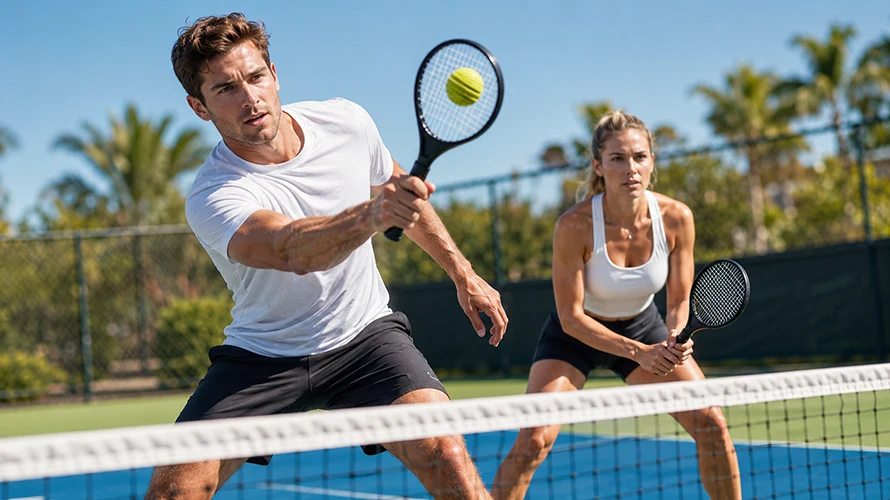
What is TYPTI? TYPTI is an emerging racket sport played on a standard pickleball court with a shorter strung racket and a soft foam ball. It blends the court accessibility of pickleball with a more tennis-like hitting feel, giving players a quieter and more spin-friendly way to play.
As more players, clubs, and sports brands look beyond traditional pickleball, TYPTI is starting to attract attention as a new small-court racket sport. This guide explains how TYPTI works, what equipment it uses, how it compares with pickleball and tennis, and why it matters for the growing racket sports market.
What Is TYPTI?
TYPTI is best understood as a hybrid racket sport built around three core elements: a pickleball-size court, a short strung racket, and a soft foam ball. According to the official TYPTI website, the sport is played on a 20×44 court with a standard pickleball net, using a 22-inch carbon fiber racket and a 3.5-inch channeled foam ball. That combination gives the sport its own identity. It is not traditional pickleball, because players do not use a solid paddle or a hard plastic ball. It is also not simply mini tennis, because the court format, ball behavior, and rally rhythm are different.
The main appeal of TYPTI is that it keeps the small-court convenience of pickleball while adding more racket-based shot-making. Players can swing more naturally, create more spin, and experience a softer ball impact. For tennis players, this may feel more familiar than pickleball. For pickleball players, it offers a different way to use the same court space.
How Does TYPTI Work?
TYPTI works like a small-court racket sport built around rallies, spin, and controlled shot-making. Players use a short strung racket to hit a soft foam ball over a standard pickleball net. The court size is familiar to pickleball players, but the hitting experience feels closer to tennis because the racket has strings instead of a solid paddle face.
The game is designed to be easier to access than full-size tennis while offering more racket-based play than traditional pickleball. The softer ball creates a different bounce and a quieter sound, while the strung racket allows players to shape shots with topspin, slice, drives, and softer touch shots.
For beginners, the easiest way to understand TYPTI is this: the court comes from pickleball, the swing feel is closer to tennis, and the foam ball gives the game its own pace and sound.
Court Size
TYPTI is played on a standard pickleball court, which is one of its biggest practical advantages. A pickleball court is much smaller than a tennis court, making the game easier to set up in clubs, recreation centers, schools, and community facilities.
This court compatibility also makes TYPTI easier to test as a new activity. Facilities that already have pickleball courts may not need to build new playing spaces before introducing the sport.
Rally Style
The rally style in TYPTI is more racket-driven than pickleball. Because players use a strung racket, they can swing through the ball more naturally and create more spin. The soft foam ball also changes the timing, bounce, and pace of each rally.
This gives TYPTI a different rhythm. It can feel more like a compact tennis rally than a traditional paddle sport exchange, especially for players who enjoy topspin, controlled drives, and longer swing paths.
Scoring and Rules
TYPTI has its own rule system, so it should not be treated as pickleball with different equipment. While the game uses a pickleball-size court and net, the equipment, ball behavior, scoring format, and rally style are different.
Because TYPTI is still an emerging sport, players, clubs, and brands should check the latest official rules before organizing formal matches or developing equipment around the sport.
What Equipment Do You Need to Play TYPTI?
To play TYPTI, you need three basic things: a short strung racket, a soft foam ball, and access to a standard pickleball court. This equipment setup is what makes TYPTI feel different from both pickleball and tennis.
Unlike pickleball, TYPTI does not use a solid paddle or a hard plastic perforated ball. The strung racket gives players more racket-based control, while the foam ball creates a softer bounce and a quieter impact sound. The court remains familiar, but the equipment changes the way the game plays.
TYPTI Racket
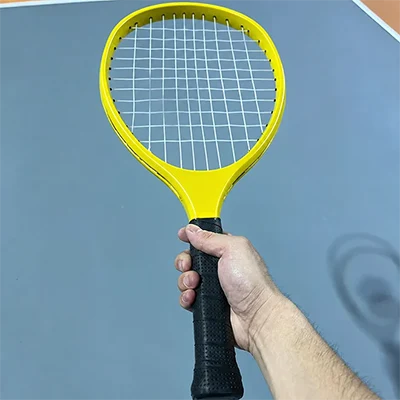
The TYPTI racket is one of the biggest differences between TYPTI and pickleball. Instead of a solid paddle, players use a shorter strung racket. This gives the game a more tennis-like contact feel and allows players to create more spin than they usually can with a flat paddle face.
Because the racket has strings, players can swing through the ball with more shape. Topspin, slice, controlled drives, and softer touch shots become a bigger part of the game. For tennis players, this may feel more natural than switching to a pickleball paddle.
From an equipment perspective, a TYPTI racket should not be treated like a pickleball paddle. The frame structure, string pattern, racket length, weight balance, and ball compatibility all affect how the product performs.
TYPTI Ball
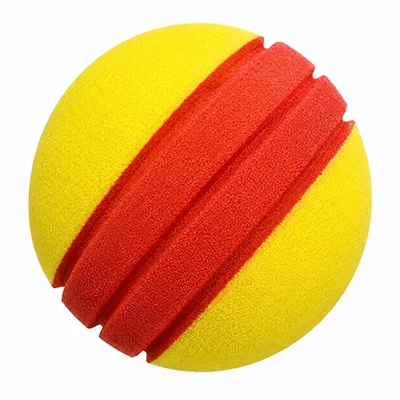
TYPTI uses a soft foam-style ball instead of a hard plastic pickleball. This changes the sound, bounce, and pace of the game. The softer ball impact is one reason TYPTI is often described as a quieter alternative to traditional pickleball.
The ball also affects how rallies develop. A foam-style ball can create a higher, softer bounce and gives players more time to shape shots. This makes TYPTI feel less like a hard paddle-ball exchange and more like a compact racket sport with longer swing paths.
For clubs and facilities, the ball is especially important because noise is one of the common concerns around pickleball courts. TYPTI is not silent, but its softer ball impact may make it easier to introduce in noise-sensitive environments.
Pickleball Court
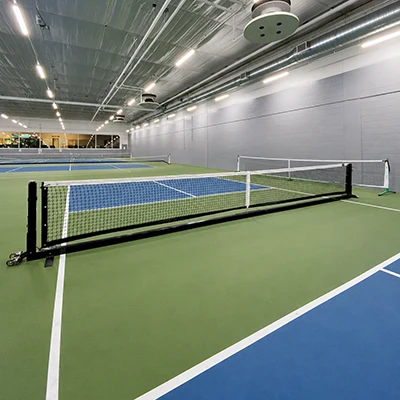
One of TYPTI’s most practical advantages is that it can be played on a standard pickleball court. This makes the sport easier to test because many clubs, parks, schools, and recreation centers already have pickleball courts available.
For players, the familiar court size lowers the entry barrier. For clubs, it means TYPTI can potentially be added as a new program without building a full-size tennis court. For brands and equipment suppliers, this court compatibility is one reason TYPTI is worth watching as the racket sports market continues to evolve.
TYPTI vs Pickleball: What’s the Difference?
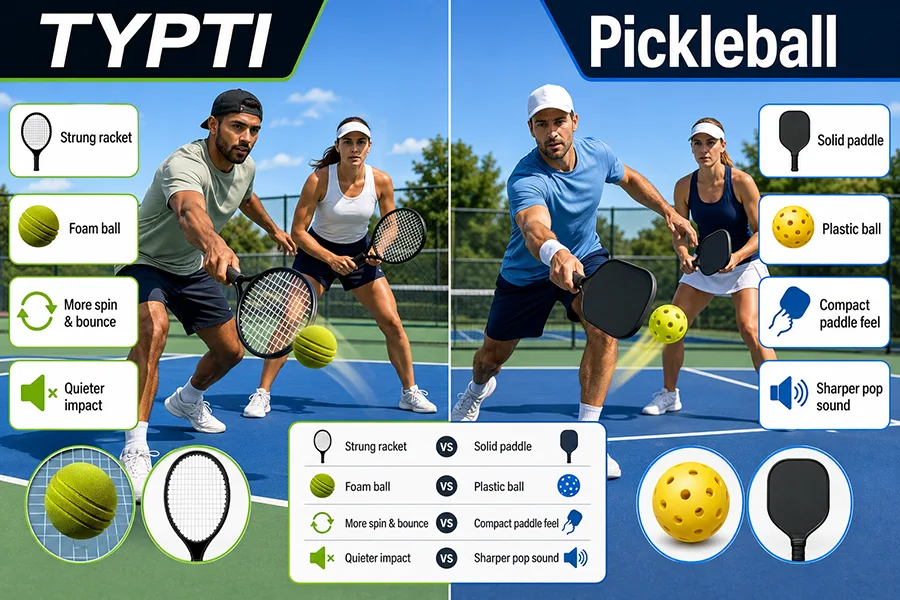
The main difference between TYPTI and pickleball is the equipment. Pickleball uses a solid paddle and a hard plastic perforated ball, while TYPTI uses a short strung racket and a soft foam ball. This changes the sound, spin, bounce, swing mechanics, and overall playing experience.
Both sports can be played on a standard pickleball court, but they do not feel the same. Pickleball is a paddle sport built around compact strokes, quick reactions, kitchen play, and controlled placement. TYPTI feels more like a small-court racket sport, with longer swings, more spin potential, and a softer ball impact.
Before comparing the two sports in detail, here is a quick side-by-side breakdown.
| Feature | TYPTI | Pickleball |
|---|---|---|
| Court | Standard pickleball court | Standard pickleball court |
| Hitting tool | Short strung racket | Solid paddle |
| Ball | Soft foam ball | Hard plastic perforated ball |
| Sound | Softer, quieter impact | Sharper paddle-ball pop |
| Swing style | More tennis-like | More compact paddle motion |
| Spin potential | Higher spin potential | Moderate spin potential |
| Bounce | Higher, softer bounce | Lower, faster plastic-ball bounce |
| Playing feel | Small-court racket sport | Paddle sport |
| Main appeal | Spin, bounce, quieter play, tennis-like feel | Easy access, fast rallies, social play, established community |
| Market stage | Emerging | Established and widely adopted |
Equipment Difference
The most obvious difference is the hitting tool. Pickleball players use a solid paddle with a flat hitting surface. TYPTI players use a short strung racket. That one change affects almost every part of the game.
With a paddle, the contact feels direct and compact. Players rely on touch, placement, blocks, dinks, drives, and quick hand speed. With a strung racket, the ball sits on the strings for a different kind of contact feel. Players can swing more naturally, shape the ball with spin, and use more tennis-style mechanics.
This does not make one sport better than the other. It simply means TYPTI and pickleball reward different skills.
Ball Difference
Pickleball uses a hard plastic perforated ball. TYPTI uses a soft foam ball. This difference changes both the sound and the behavior of the ball after contact. If you want to understand the standard ball used in pickleball, our guide on what is a pickleball ball explains its size, hole count, bounce, durability, and buying factors.
A pickleball moves quickly off the paddle and creates the familiar sharp popping sound. A TYPTI ball has a softer impact and a different bounce profile. It can feel easier to shape with spin and may give players more time to prepare for the next shot.
This is also why TYPTI is often discussed as a quieter court-sport option. It is not silent, but the foam ball produces a less sharp impact sound than a hard plastic pickleball.
Playing Feel Difference
Pickleball is built around compact movement, quick exchanges, soft shots near the kitchen, and fast reactions. It is easy to learn, social, and already supported by a large player base.
TYPTI has a different rhythm. Because players use a strung racket and foam ball, rallies can feel more like compact tennis exchanges. Players may use longer swing paths, topspin, slice, and controlled drives more often than they would in traditional pickleball.
For a tennis player, TYPTI may feel more familiar. For a pickleball player, it may feel like a different way to use the same court space.
Noise Difference
Noise is one reason TYPTI has started to attract attention. Pickleball’s sound mainly comes from a hard plastic ball striking a solid paddle. In some communities, that repeated popping sound has created complaints around residential courts.
TYPTI changes the sound profile by using a foam ball and a strung racket. The impact is generally softer and less sharp. That may make TYPTI more appealing for indoor facilities, residential communities, schools, and clubs that want a quieter racket sport option.
Still, quieter does not mean silent. Any racket sport produces sound from ball impact, movement, voices, and court activity.
TYPTI vs Tennis: Is TYPTI Just Mini Tennis?
TYPTI is not simply mini tennis. It borrows the strung-racket feel and swing mechanics of tennis, but it uses a smaller pickleball court, a softer foam ball, and a different rally rhythm. The result is a hybrid small-court racket sport rather than a reduced version of traditional tennis.
For tennis players, TYPTI may feel familiar because the racket has strings. Players can swing through the ball, create topspin, use slice, and shape shots in ways that feel closer to tennis than pickleball. This makes TYPTI appealing to players who enjoy racket-based shot-making but do not always want the movement demands of a full-size tennis court.
The biggest difference is the court. Tennis requires a much larger playing area, while TYPTI is designed around the footprint of a pickleball court. This makes TYPTI easier to introduce in clubs, schools, recreation centers, and community facilities that already have pickleball courts available.
The ball also changes the game. A tennis ball is pressurized and designed for a full-size court. A TYPTI ball is softer and lighter, which creates a different bounce, pace, and sound. Players still need timing, control, and footwork, but the game is not built around the same speed, distance, and court coverage as tennis.
So, TYPTI can be described as tennis-inspired, but not tennis itself. It gives players some of the racket feel and spin potential of tennis while keeping the smaller-court accessibility that helped pickleball grow.
| Feature | TYPTI | Tennis |
|---|---|---|
| Court | Standard pickleball court | Full-size tennis court |
| Hitting tool | Short strung racket | Full-size tennis racket |
| Ball | Soft foam ball | Pressurized tennis ball |
| Playing feel | Small-court hybrid racket sport | Traditional full-court racket sport |
| Movement demand | Lower court coverage | Higher court coverage |
Why Is TYPTI Getting Attention?
TYPTI is getting attention because it connects with several trends in the racket sports market at the same time. It uses existing pickleball courts, offers a softer and quieter ball impact, gives tennis players a more familiar racket feel, and creates a new way for clubs and brands to think about small-court sports.
Its timing also matters. Pickleball has already made small-court racket sports more visible, especially in clubs, parks, recreation centers, and residential communities. TYPTI enters the market with a different playing feel while still using the same court footprint, which makes it easier for people to understand and test.
The sport is still emerging, so it is too early to say how large the market will become. But for players, clubs, brands, and equipment suppliers, TYPTI is worth watching because it shows how quickly the court-sports category is evolving.
It Uses Existing Pickleball Courts
One of the biggest reasons TYPTI is getting attention is court compatibility. New sports usually face a major barrier: they need space. TYPTI lowers that barrier by using a standard pickleball court instead of requiring a full-size tennis court or a new custom playing area.
This makes the sport easier to test in clubs, schools, parks, and recreation centers. If a facility already has pickleball courts, it may be able to introduce TYPTI through trial sessions, demo days, or small group programming before making a larger investment.
It May Reduce Noise Concerns
Pickleball noise has become a real concern in some communities, especially near residential courts. The repeated pop of a hard plastic ball striking a solid paddle can be sharp and noticeable.
TYPTI changes the sound profile by using a softer foam ball and a strung racket. This does not make the sport silent, but it can create a softer impact sound than traditional pickleball. For clubs, schools, and residential communities, that quieter profile may be one reason to test the sport.
It Appeals to Tennis Players
TYPTI may also attract tennis players who want a more familiar hitting feel than pickleball. The short strung racket allows players to swing through the ball, create spin, and use more tennis-style mechanics.
For former tennis players, this can make TYPTI easier to understand. They do not need a full-size tennis court, but they still get a racket-based game with topspin, slice, drives, and controlled shot-making. That gives TYPTI a different player appeal from traditional pickleball.
It Creates a New Equipment Category
TYPTI also matters because new racket sports can create new equipment demand. If the sport continues to grow, brands and suppliers may need to look at short strung rackets, foam balls, starter sets, bags, court accessories, and club equipment packages.
For equipment manufacturers, this does not mean rushing into production without research. A TYPTI racket is not the same as a pickleball paddle, and product development would require careful study of specifications, materials, frame structure, string systems, and market demand.
Is TYPTI Quieter Than Pickleball?
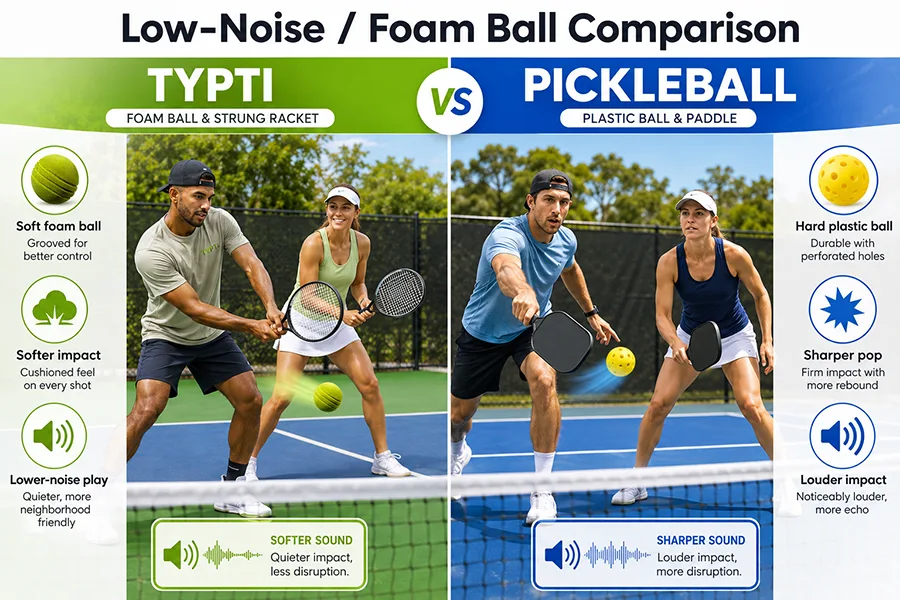
TYPTI is generally described as quieter than pickleball because it uses a soft foam ball instead of a hard plastic ball striking a solid paddle. The softer ball impact can reduce the sharp popping sound that often causes noise complaints around pickleball courts.
This difference comes mainly from the equipment. In pickleball, the sound is created when a hard plastic perforated ball hits a rigid paddle face. That contact produces a crisp, repeated pop, especially during fast rallies. In TYPTI, the foam ball creates a softer impact, and the strung racket absorbs contact differently from a solid paddle.
For clubs, schools, recreation centers, and residential communities, this quieter sound profile may be one reason to test TYPTI. It may be especially useful in places where pickleball noise has become a concern or where indoor court sound needs to be managed more carefully. For facilities that want lower-noise options within traditional pickleball, quiet pickleball balls can also help support softer, more community-friendly play.
Still, quieter does not mean silent. TYPTI will still create sound from racket contact, footwork, player movement, voices, and general court activity. The better way to describe it is a lower-noise racket sport option, not a completely silent alternative to pickleball.
Is TYPTI Really a New Sport?
TYPTI is promoted as a new racket sport, but it should also be understood within the broader family of small-court racket games. It is not the first sport to combine a smaller court, a strung racket, and a softer ball. However, TYPTI has its own identity because of how these elements are packaged together.
The main difference is its specific format. TYPTI is designed around a standard pickleball court, a short strung racket, a soft foam ball, and its own rule system. That combination separates it from traditional pickleball, full-size tennis, and other reduced-court racket games.
This distinction matters because new sports are rarely created in isolation. They often borrow ideas from existing games, then reorganize them into a new format with different equipment, branding, rules, and player experience. TYPTI fits that pattern.
So, is TYPTI really new? The safest answer is yes, as a branded and structured racket sport format. But it is not completely disconnected from earlier small-court racket sports. Its real uniqueness comes from its timing, its pickleball-court compatibility, and its attempt to offer a more tennis-like playing feel in a smaller, quieter format.
Will TYPTI Replace Pickleball?
TYPTI is unlikely to replace pickleball in the short term. Pickleball already has a large player base, established equipment supply, organized events, strong community adoption, and broad recreational awareness. TYPTI is still an emerging sport, so it needs time to prove whether players, clubs, and brands will adopt it at scale.
A better way to understand TYPTI is as an adjacent racket sport. It uses the same court footprint as pickleball, but it offers a different playing experience through its strung racket and soft foam ball. That means the two sports may share court space without serving exactly the same type of player.
Pickleball is easier to access today because equipment, coaching, courts, leagues, and player communities are already widely available. TYPTI may appeal more to players who want tennis-style swings, more spin, higher bounce, or quieter rallies. These are different needs, not necessarily competing needs.
For clubs and recreation centers, TYPTI could become an additional programming option. A facility might keep pickleball as its main sport while testing TYPTI through demo days, beginner sessions, or special events. That kind of coexistence is more realistic than full replacement.
For brands and equipment suppliers, the takeaway is similar. TYPTI is not a reason to move away from pickleball. It is a signal that the small-court racket sports market is still evolving. If TYPTI gains traction, it may create a new equipment category alongside pickleball rather than replacing it.
What Does TYPTI Mean for Pickleball Brands, Clubs, and Equipment Suppliers?
For pickleball brands, clubs, and equipment suppliers, TYPTI represents an emerging category to monitor rather than an immediate replacement for pickleball. If the sport gains adoption, it may create demand for short strung rackets, foam balls, starter sets, bags, court accessories, and club equipment packages.
The most important point is that TYPTI uses a familiar court format but a different equipment system. This makes it interesting for facilities that already have pickleball courts and for brands watching the growth of small-court racket sports. However, it also means companies should avoid treating TYPTI as just another version of pickleball.
For the market, TYPTI is a signal. It shows that court-based sports are still evolving, and that players may continue looking for new formats with different sound, spin, bounce, and playing feel. For B2B buyers, the question is not only whether TYPTI becomes popular, but whether new racket sport formats can create fresh equipment opportunities.
For Clubs and Court Operators
For clubs and court operators, TYPTI may become an additional programming option. Because it can be played on a standard pickleball court, facilities may be able to test the sport without building a new court system.
This could make TYPTI useful for demo days, beginner sessions, mixed racket-sport events, indoor programming, or noise-sensitive locations. It may also help clubs attract tennis players who want a racket-based game but prefer a smaller court format.
The key is to test demand before making large commitments. Clubs can start by evaluating player interest, equipment availability, court scheduling, coaching needs, and whether TYPTI fits their existing member base.
For Pickleball Brands
For pickleball brands, TYPTI is worth watching because it sits close to the pickleball market but does not use the same equipment. If player interest grows, brands may explore adjacent products such as short strung rackets, foam balls, bags, starter sets, and club packages.
At the same time, brands should avoid rushing into the category without research. TYPTI has its own product specifications, rules, positioning, and potential intellectual property considerations. A pickleball paddle brand cannot assume that existing paddle designs, materials, or production methods will directly transfer to TYPTI equipment.
A practical approach is to monitor search demand, club adoption, player feedback, retail availability, and official product standards before deciding whether to enter the category.
For Equipment Suppliers and Manufacturers
For equipment suppliers and manufacturers, TYPTI highlights a broader point: new racket sports can create new product categories, but they also require careful product development. A TYPTI racket is not the same as a pickleball paddle. The frame, string system, racket length, weight balance, durability, and ball interaction all need separate testing.
The foam ball also introduces a different development path from standard pickleball balls. Material density, bounce behavior, durability, surface texture, and noise profile may all affect how the ball performs in real play.
For B2B manufacturers, the safest position is to treat TYPTI as a trend to study carefully. Before producing or marketing TYPTI-related equipment, companies should confirm product specifications, market demand, intellectual property risks, and any brand or licensing restrictions.
As a B2B pickleball equipment manufacturer, Art Pickleball follows emerging racket sport trends because new court-based sports can influence product development, private-label programs, and wholesale equipment demand.
Should You Try TYPTI?
TYPTI may be worth trying if you enjoy racket sports but want something different from traditional pickleball or full-size tennis. It gives players a smaller court, a softer ball, a quieter sound, and a more tennis-like swing feel.
For tennis players, TYPTI may feel more natural than pickleball because it uses a strung racket. You can swing through the ball, create spin, and shape shots in a familiar way. For pickleball players, TYPTI offers a different experience on the same type of court, especially if you want more bounce, more spin, and a softer ball impact.
TYPTI may be a good fit if you:
- Like tennis-style swings
- Already play pickleball
- Want more spin and bounce
- Prefer a quieter court experience
- Play in a noise-sensitive community
- Manage a club or recreation center
- Want to test a new small-court racket sport
That said, TYPTI is still emerging. Depending on your location, equipment and organized play may not be as easy to find as pickleball. If you are a player, it is best to try it first before comparing it directly with pickleball or tennis. If you are a club or brand, it is better to test demand before making a larger investment.
FAQs about TYPTI
Q1. Does TYPTI have a kitchen rule?
No. TYPTI does not use the traditional pickleball kitchen rule, also known as the non-volley zone rule. Players can generally volley from anywhere on the court, which changes the strategy and makes the game feel more racket-driven than traditional pickleball.
Q2. What is the Net Rebound Rule in TYPTI?
The Net Rebound Rule is one of TYPTI’s more unusual features. If the ball hits the net during play, the rally may continue instead of ending immediately. This can create unexpected saves, longer points, and a more dynamic rally style than many traditional court sports.
Q3. What is Stakes Scoring in TYPTI?
Stakes Scoring is TYPTI’s own scoring method, designed to make points feel important throughout a match. Because TYPTI is still developing as a sport, players and clubs should check the latest official rules before organizing formal games or events.
Q4. Who is TYPTI best suited for?
TYPTI may suit tennis players who want a smaller court, pickleball players who want more spin and bounce, and clubs looking for new racket-sport programming. It may also appeal to communities that want a softer-sounding alternative to traditional pickleball.
Q5. Where can you buy TYPTI equipment?
TYPTI equipment is still an emerging category, so availability may vary by market. Players should choose reputable suppliers for rackets and balls. For brands, clubs, and distributors looking to test this new racket-sport category, Art Pickleball offers custom TYPTI-style equipment solutions with MOQ starting from 100 pcs. Buyers should confirm official specifications, licensing, and IP requirements before mass production.